Restricting Copper Reconstruction with Ultrathin Polydopamine for Selective and Stable Electrochemical CO₂ Reduction Reaction to C₂ Products
以超薄聚多巴胺限制銅重構以實現選擇性且穩定的電化學CO₂還原反應產生C₂產物
📄 英文摘要
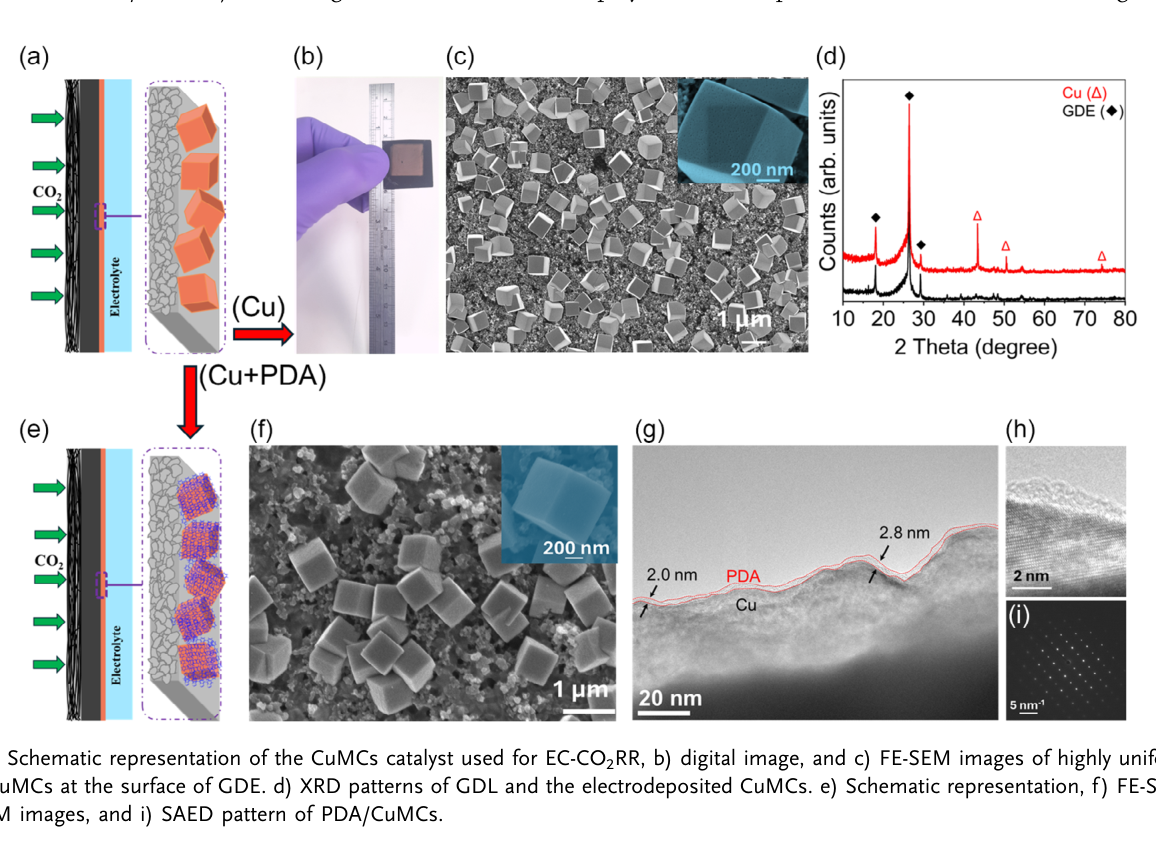
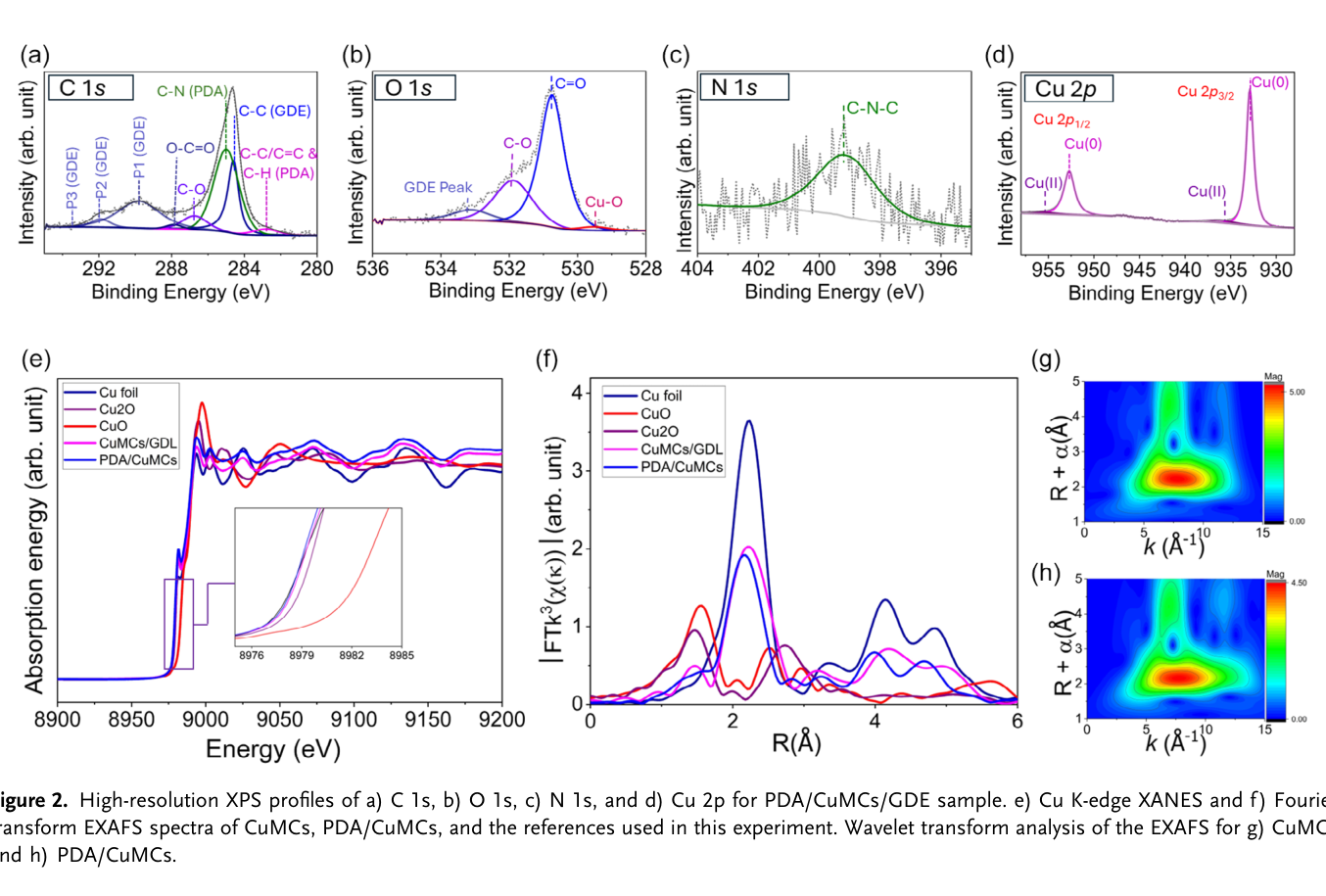
A strategy is presented to mitigate copper surface reconstruction during electrochemical CO₂ reduction reaction (EC-CO₂RR) by conformally coating copper microcubes (CuMCs) with an ultrathin (2 nm) polydopamine (PDA) layer. The formation of nanocubes (30–50 nm in size) at the surface of microcubes at the early stages of the EC-CO₂RR contributes to suppressed surface reconstruction and sustained Faradaic efficiency (FE) for C₂ products. Furthermore, PDA coating effectively stabilizes adsorbed COatop and CObridge intermediates and promotes C─C coupling. As a result, the FE for C₂ products increases from 52.0 ± 4.0% for unmodified CuMCs to 81.6 ± 2.8% for PDA-coated CuMCs at −1.18 V versus reversible hydrogen electrode (VRHE). The PDA coating effectively slows down the surface evolution process of the catalyst during electrolysis. After 18 h of continuous operation at −0.88 VRHE, the CuMCs retain their original framework owing to a tightly adhered PDA layer that effectively stabilizes the surface and enhances catalyst durability. In situ surface-enhanced infrared absorption spectroscopy confirms the presence of adsorbed COatop, CObridge, and *OCCOH intermediates on PDA/CuMCs surface, which are believed to boost C─C coupling. This work highlights the potential of polymer film to stabilize the catalyst surface and steer product distribution in CO₂ electroreduction.
📄 中文摘要
本研究提出一種在電化學二氧化碳還原反應(EC-CO₂RR)過程中,透過在銅微立方體(CuMCs)上以共形塗覆超薄(2 nm)聚多巴胺(PDA)層來緩解銅表面重構的策略。在 EC-CO₂RR 早期階段,微立方體表面形成的 nanocubes(30–50 nm)有助於抑制表面重構並維持 C₂ 產物的法拉第效率(FE)。此外,PDA 塗層可有效穩定吸附的中間產物 COatop 與 CObridge,並促進 C─C 耦合。C₂ 產物的 FE 由未修飾 CuMCs 的 52.0 ± 4.0% 提升至 PDA 塗覆 CuMCs 在 −1.18 V(相對於可逆氫電極,VRHE)下的 81.6 ± 2.8%。PDA 塗層有效減緩了電解過程中觸媒的表面演化。在 −0.88 VRHE 下連續操作 18 小時後,CuMCs 仍保留其原始框架,這得益於緊密附著於表面的 PDA 層,其有效穩定了表面並增強了觸媒的耐久性。in situ 表面增強紅外吸收光譜確認了 PDA/CuMCs 表面上存在吸附的 COatop、CObridge 與 *OCCOH 中間產物,這些被認為是促進 C─C 耦合的關鍵。本工作展示了高分子薄膜在穩定觸媒表面及調控 CO₂ 電還原中產物分布的潛力。
🔬 五項核心重要發現
📊 關鍵圖表