High-Entropy Oxide of (BiZrMoWCeLa)O₂ as a Novel Catalyst for Vanadium Redox Flow Batteries
高熵氧化物 (BiZrMoWCeLa)O₂ 作為釩氧化還原液流電池之新型觸媒
📄 英文摘要
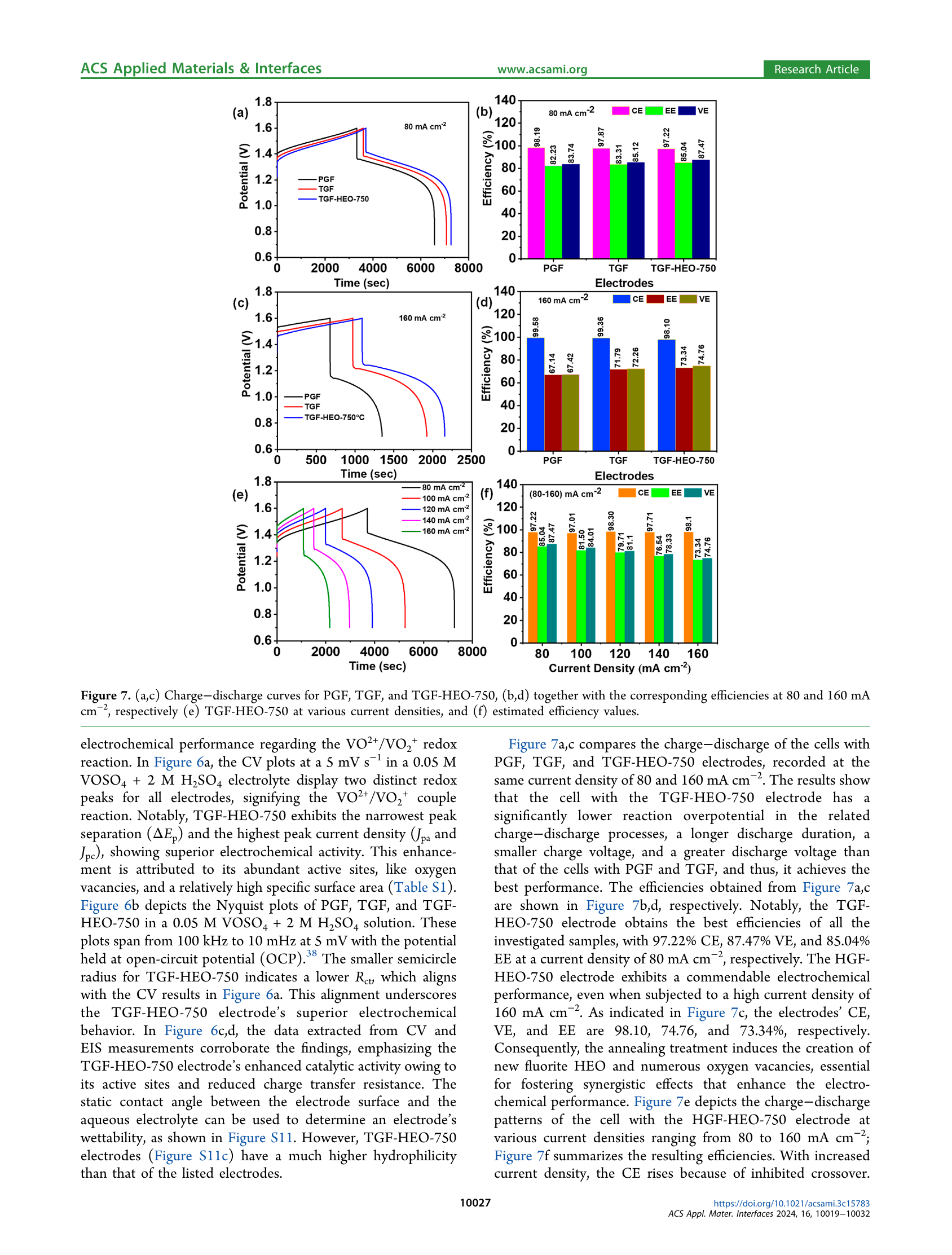
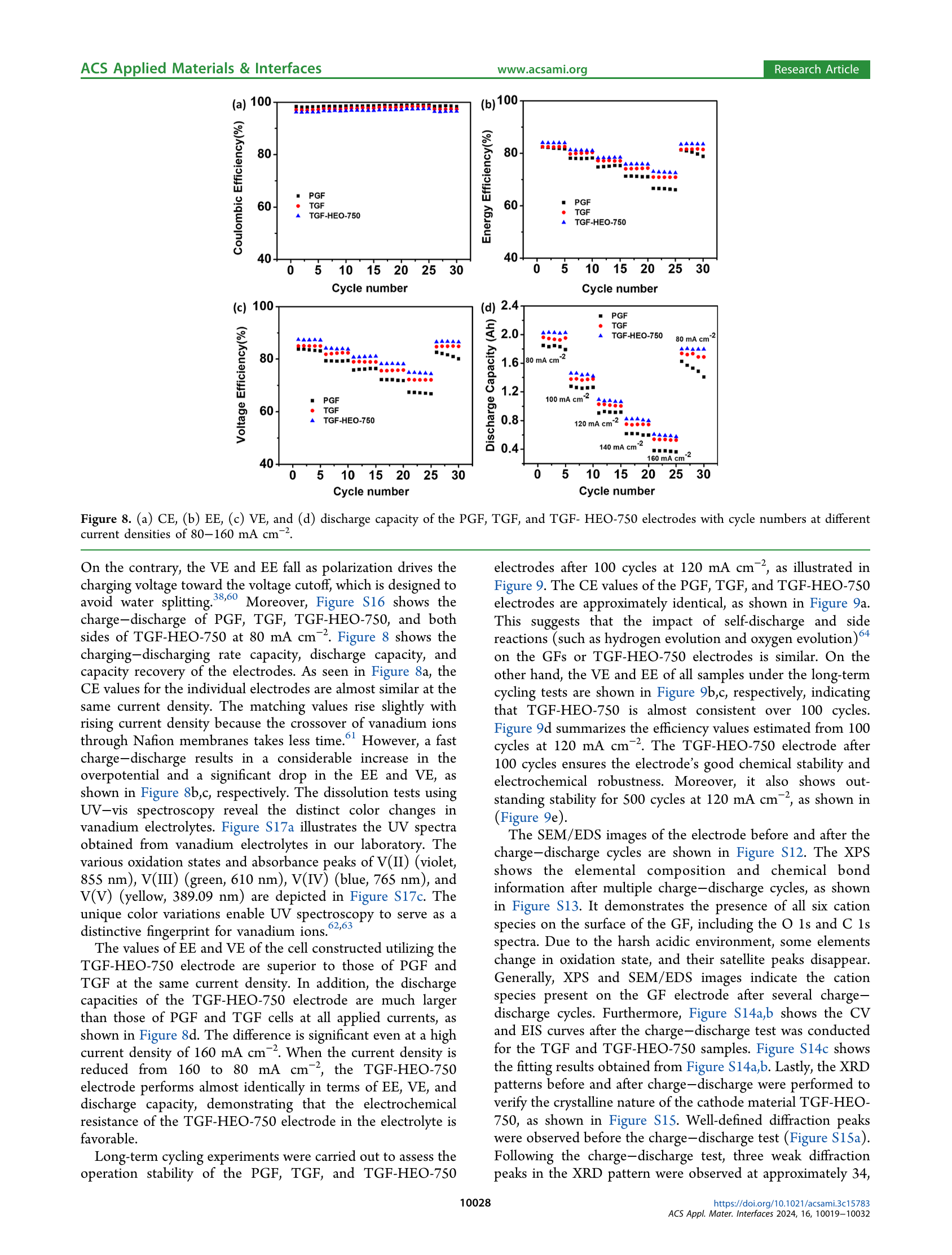
In this study, new fluorite high-entropy oxide (HEO), (BiZrMoWCeLa)O₂, nanoparticles were produced using a surfactant-assisted hydrothermal technique followed by calcination and were used as novel catalytic materials for vanadium redox flow batteries (VRFBs). The HEO calcined at 750 °C (HEO-750) demonstrates superior electrocatalytic activity toward V³⁺/V²⁺ and VO₂⁺/VO²⁺ redox couples compared to those of cells assembled with other samples. The charge−discharge tests further confirm that VRFBs using the HEO-750 catalyst demonstrate excellent Coulombic efficiency, voltage efficiency, and energy efficiency of 97.22, 87.47, and 85.04% at a current density of 80 mA cm⁻² and 98.10, 74.76, and 73.34% at a higher current density of 160 mA cm⁻², respectively. Moreover, with 500 charge−discharge cycles, there is no discernible degradation. These results are attributed to the calcination heat treatment, which induces the formation of a new single-phase fluorite structure, which facilitates the redox reactions of the vanadium redox couples. Furthermore, a high surface area, wettability, and plenty of oxygen vacancies can give more surface electroactive sites, improving the electrochemical performance, the charge transfer of the redox processes, and the stability of the VRFBs' electrode. This is the first report on the development of fluorite structure HEO nanoparticles in VRFBs, and it opens the door to further research into other HEOs.
📄 中文摘要
本研究以表面活性劑輔助水熱法結合退火處理,合成新型氟石結構高熵氧化物(HEO)(BiZrMoWCeLa)O₂ 奈米粒子,並將其作為釩氧化還原液流電池(VRFBs)的新型觸媒材料。於 750°C 退火之 HEO-750 樣品,對 V³⁺/V²⁺ 與 VO₂⁺/VO²⁺ 氧化還原對展現優異的電催化活性,優於其他樣品組裝的電池。充放電測試進一步確認,使用 HEO-750 觸媒的 VRFB 在 80 mA cm⁻² 電流密度下,庫倫效率、電壓效率與能量效率分別達 97.22%、87.47% 與 85.04%;在較高電流密度 160 mA cm⁻² 下,則為 98.10%、74.76% 與 73.34%。此外,歷經 500 次充放電循環,未見明顯衰減。此卓越性能歸因於退火熱處理誘導形成的新型單相氟石結構,促進了釩氧化還原對的氧化還原反應。同時,高比表面積、良好浸潤性與豐富氧空位提供了更多表面電活性位點,提升了電化學性能、電荷轉移與 VRFB 電極穩定性。本研究為氟石結構 HEO 奈米粒子應用於 VRFB 的首篇報告,為其他 HEO 的進一步研究開闢了新道路。
🔬 五項核心重要發現
📊 關鍵圖表