Molecular engineering, supporting electrolyte, and membrane selections for enhanced cycling stability of non-aqueous organic redox flow batteries: A review
非水系有機氧化還原流電池之分子工程、輔助電解質與膜選擇:提升循環穩定性之文獻回顧
📄 英文摘要
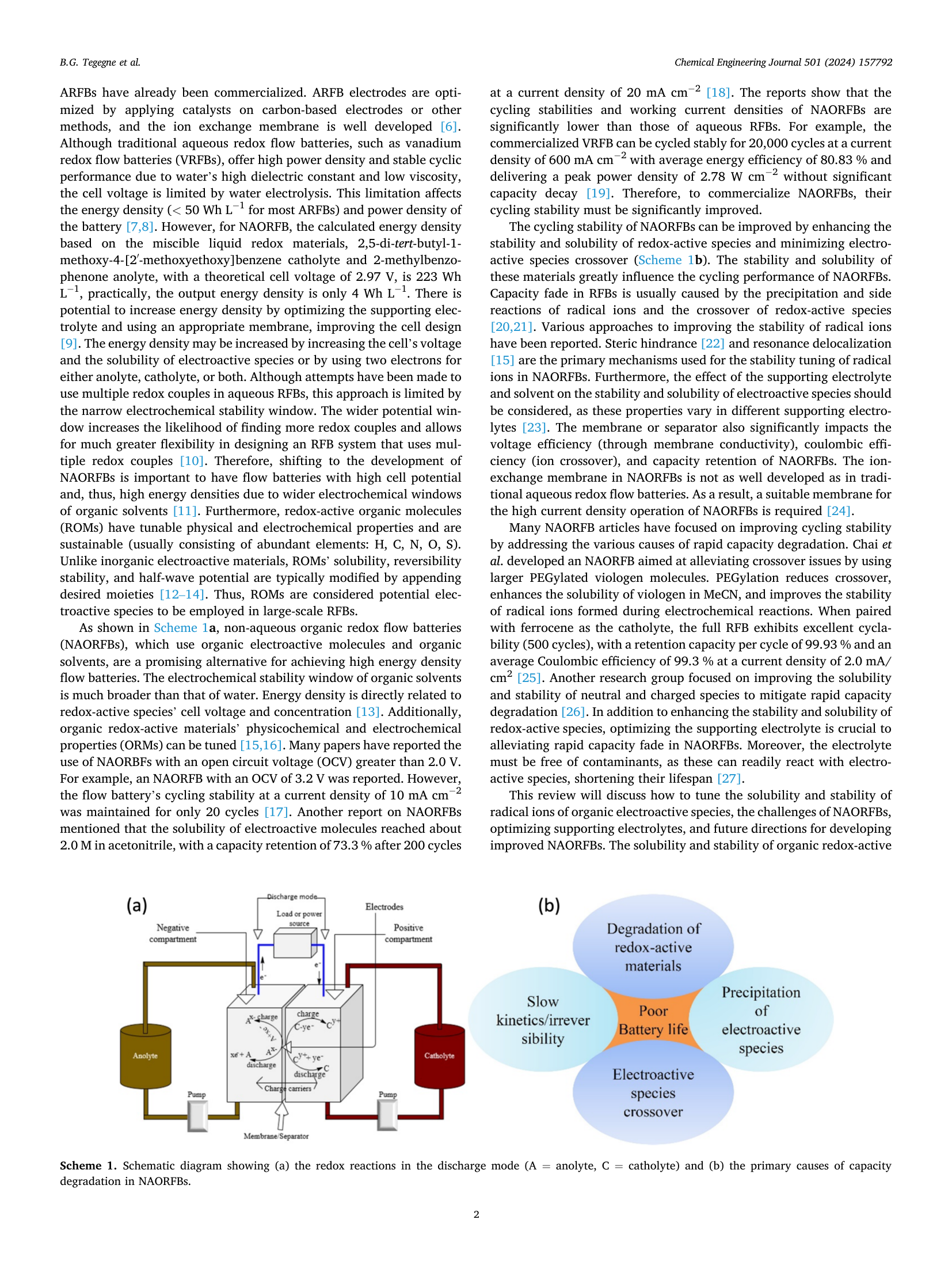
Redox flow batteries (RFBs) have attracted researchers due to their decoupled nature of energy and power modulations, suitability for large-scale stationary energy storage, and integration of renewable intermittent energy sources such as solar and wind power. Water's narrow electrochemical stability window limits the energy density of aqueous redox flow batteries. Thus, a shift to non-aqueous organic redox flow batteries (NAORFBs) is necessary to achieve high energy density while benefiting from organic solvents' expansive electrochemical stability windows. Nonetheless, the degradation and crossover of organic electroactive materials cause rapid capacity loss in NAORFBs. To improve the cycling stability of NAORFBs, molecular engineering is required to enhance the stability of redox-active species, particularly charged species, and the solubility of redox-active species. An appropriate ion-selective membrane that mitigates crossover by selectively allowing the passage of ions of supporting salts needs to be developed. This review discusses molecular design strategies that may improve radical ion stability, increase the solubility of redox-active species, and reduce redox-active species crossover and the selection of appropriate supporting electrolytes and separators/membranes for the overall enhancement of the cycle life and performance.
📄 中文摘要
氧化還原流電池(RFB)因其能量與功率調控相互獨立、適合大規模定置型儲能,以及可整合太陽能與風力發電等間歇性再生能源而受到研究者關注。水狹窄的電化學穩定窗口限制了水系氧化還原流電池的能量密度。因此,轉向非水系有機氧化還原流電池(NAORFB)可在利用有機溶劑更寬的電化學穩定窗口同時實現高能量密度。然而,有機電活性材料的降解與 crossover(交叉遷移)導致 NAORFB 快速容量衰減。為提升 NAORFB 的循環穩定性,分子工程技術可用於增強氧化活性物種(尤其是帶電物種)的穩定性與溶解度,同時需開發適當的離子選擇性膜以透過選擇性通透輔助鹽離子來減少 crossover。本回顧文探討分子設計策略如何提升游離基離子穩定性、增加氧化活性物種的溶解度、減少氧化活性物種的 crossover,以及如何選擇適當的輔助電解質與隔膜/膜,以全面提升循環壽命與效能。
🔬 五項核心重要發現
📊 關鍵圖表