Molybdenum-doped NiCo₂O₄ nanowires with enriched oxygen vacancies for wide-current-density VRFBs
摻雜鉬的富含氧空位 NiCo₂O₄ 奈米線:用於寬電流密度全釩液流電池(VRFBs)
📄 英文摘要
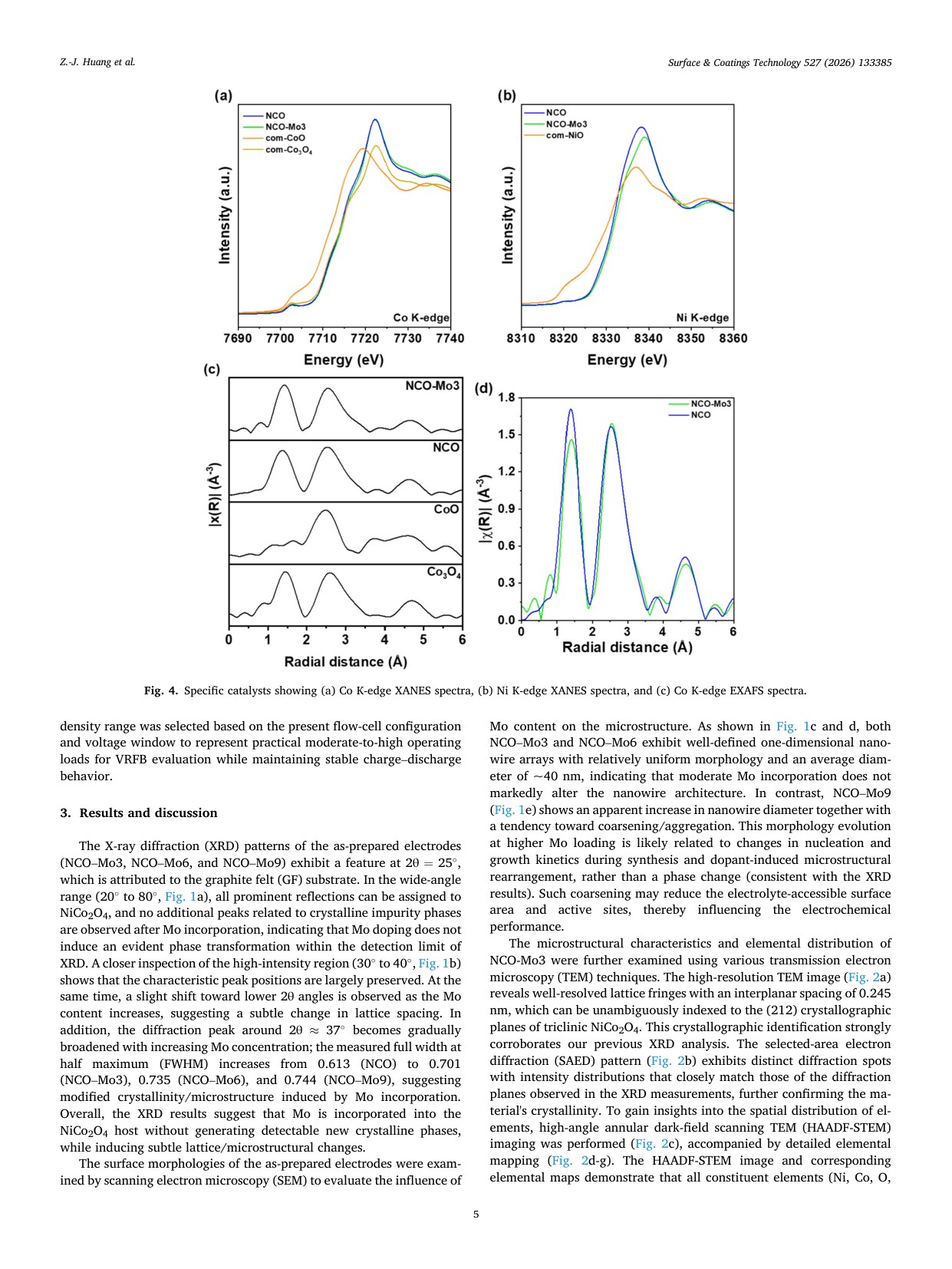
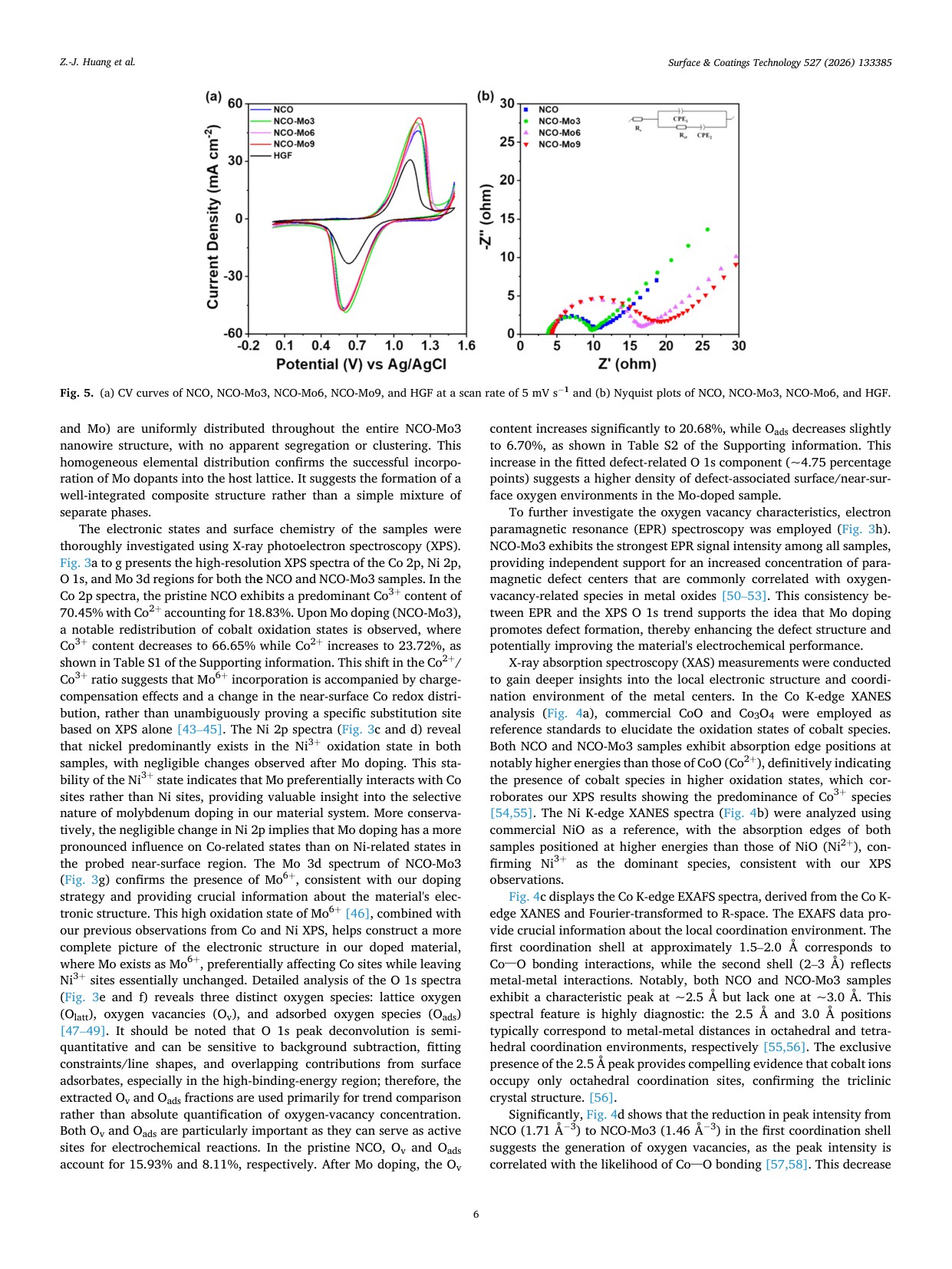
Molybdenum-doped nickel–cobalt oxide (NCO–Mo) nanowires were directly grown on graphite felt to construct high-performance electrodes for vanadium redox flow batteries (VRFBs). Morphological and structural characterizations (XRD, HAADF-STEM, XPS, XANES, and EXAFS) confirm a well-integrated nanowire coating with uniform elemental distribution and Mo incorporation into the NiCo₂O₄ host without detectable crystalline impurity phases. Mo incorporation induces oxygen vacancies (+4.75 percentage points) and modulates near-surface electronic states, which are expected to benefit interfacial charge transfer and provide abundant active sites for vanadium redox reactions. Electrochemical tests demonstrate that the optimized NCO–Mo₃ electrode delivers an energy efficiency of 86.96% at 80 mA cm⁻², 12.3 percentage points higher than pristine graphite felt (74.68%). Notably, it maintains strong performance over a wide current-density range (80–260 mA cm⁻²), achieving 63.46% efficiency at the maximum current density. The electrode also exhibits excellent durability over 250 charge–discharge cycles with coulombic efficiency above 97% and negligible performance decay (<0.2% per cycle). Mechanistically, oxygen-vacancy-mediated defect engineering reduces charge-transfer resistance, suppresses hydrogen evolution, and enhances intrinsic catalytic activity toward the VO₂⁺/VO²⁺ redox reactions.
📄 中文摘要
本研究將鉬摻雜的鎳鈷氧化物(NCO–Mo)奈米線直接生長在石墨氈上,用以建構高效能的全釩氧化還原液流電池(VRFB)電荷。結構表徵(XRD、HAADF-STEM、XPS、XANES 及 EXAFS)確認該奈米線塗層整合良好、元素分佈均勻,且鉬成功摻入 NiCo₂O₄ 基體中,未偵測到結晶雜相。鉬的摻入誘導產生氧空位(增加 4.75 個百分點),並調節了近表面的電子狀態,有利於界面電荷傳遞,並為釩的氧化還原反應提供豐富的活性位點。電化學測試顯示,優化的 NCO–Mo₃ 電荷在 80 mA cm⁻² 下的能量效率為 86.96%,比原始石墨氈(74.68%)高出 12.3 個百分點。值得注意的是,該電荷在寬電流密度範圍(80–260 mA cm⁻²)內維持強勁性能,在最大電流密度下仍達到 63.46% 的效率。此外,該電荷在 250 次充放電循環中展現優異的耐用性,庫倫效率保持 97% 以上,且性能衰減極低(每循環 < 0.2%)。機理分析表明,氧空位介導的缺陷工程:① 降低了電荷傳遞阻力、② 抑制了氫氣析出(HER)、③ 增強了 VO₂⁺/VO²⁺ 氧化還原反應的本徵催化活性。這些發現強調了氧空位調節的鉬摻雜是設計寬電流密度 VRFB 電荷的一般性策略。
🔬 五項核心重要發現
📊 關鍵圖表