← Back to CO₂ Reduction Research
🤝 Collaborative Paper

Capped Vapor−Liquid−Solid Growth of Vanadium-Substituted MoS₂ Ultrathin Films for Enhanced Photocatalytic Activity

ACS Nano, 20 (2026) 2211–2224 (ACS Publications) | DOI: 10.1021/acsnano.5c17367
Authors:Pin-Pin Huang, Mohammad Qorbani, Ying-Ti Hung, Ying-Ren Lai, Amr Sabbah, Mao-Feng Tseng, Chih-Yang Huang, Sumangaladevi Koodathil, Septia Kholimatussadiah, Mahmoud Kamal Hussien, Tzu-Hsuan Feng, Yo-Hsun Liu, Hsin Wang, Jia-Wei Lin, Chen-Hao Wang, Chih-I Wu, Michitoshi Hayashi, Kuei-Hsien Chen, and Li-Chyong Chen*

📄 Abstract

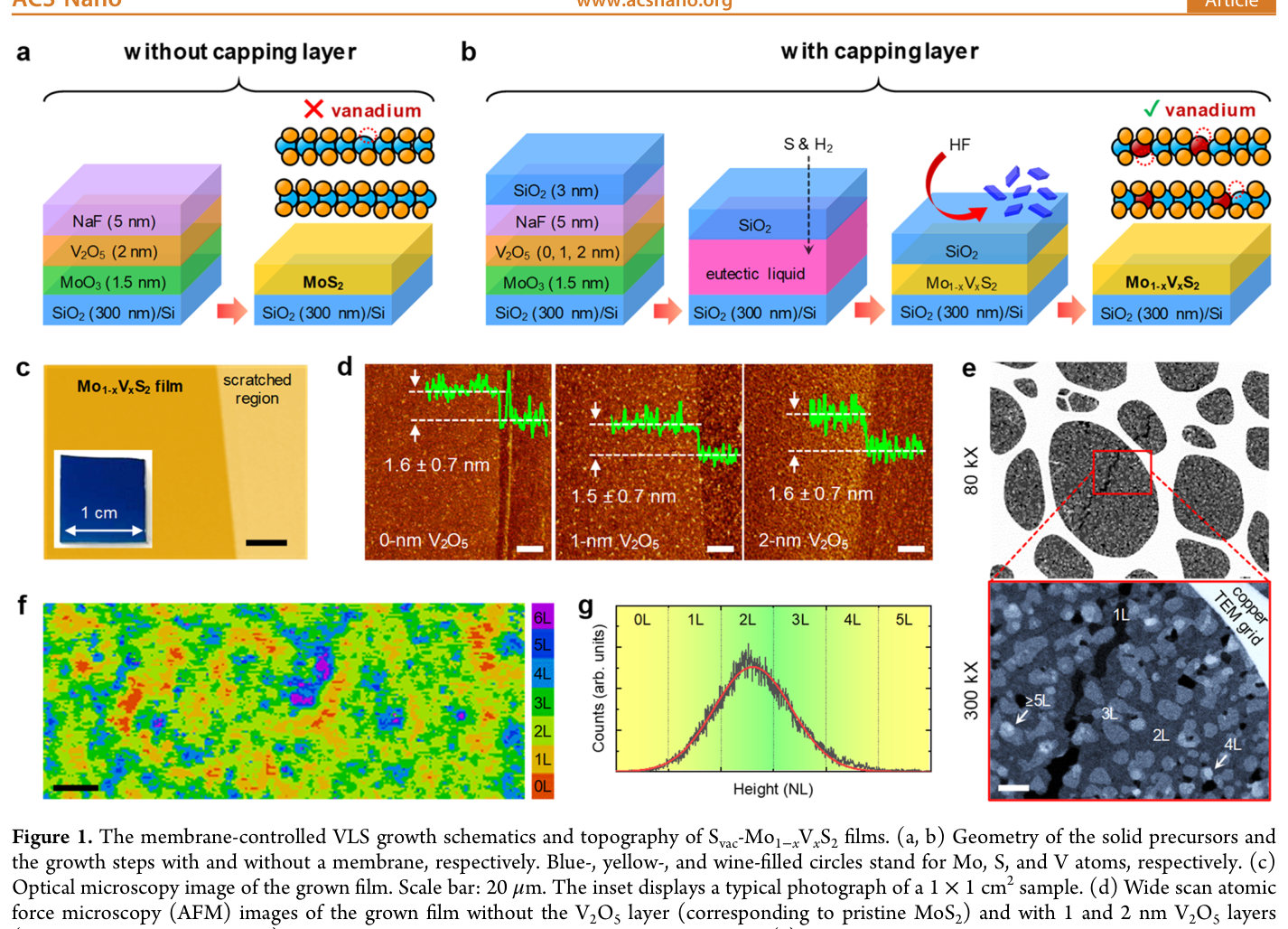
This work reports a SiO₂-capped vapor−liquid−solid (VLS) growth method that substitutes vanadium into MoS₂ ultrathin film and introduces sulfur vacancies to form Svac-Mo₁₋ₓVₓS₂. By optimizing the thickness of solid precursors and the SiO₂-capping layer as well as the growth temperature, we control film thickness, vanadium concentration, and film uniformity. The presence of V−Svac pairs enhances Svac concentration and charge density transfer among V−S−Mo atoms, with multifaceted benefits including enhanced light absorption, photoluminescence quenching, crystal structure distortion, efficient binding of CO₂ or H₂O, improved charge transfer/transport, and suitable energy band alignment. The 2D Svac-Mo₁₋ₓVₓS₂ exhibits stable and boosted photocatalytic CO₂ reduction to CO, yielding approximately 5× more than pristine MoS₂.

🔬 Five Key Findings

1
SiO₂-capped VLS growth: First method to simultaneously achieve V substitution and S vacancy introduction, overcoming basal plane inertness of MoS₂.
2
~5× CO yield enhancement in photocatalytic CO₂ reduction vs. pristine MoS₂.
3
V−Svac pair active sites: Synergistic dopant−vacancy pairing significantly enhances basal plane activation and charge-transfer kinetics.
4
Multifaceted optoelectronic benefits: Enhanced light absorption, photoluminescence quenching, crystal distortion, improved charge transfer/transport, and suitable energy band alignment.
5
Dopant−vacancy pairing strategy: Provides a universal methodology for designing efficient photocatalysts via defect-dopant pairing.

📊 Key Figures

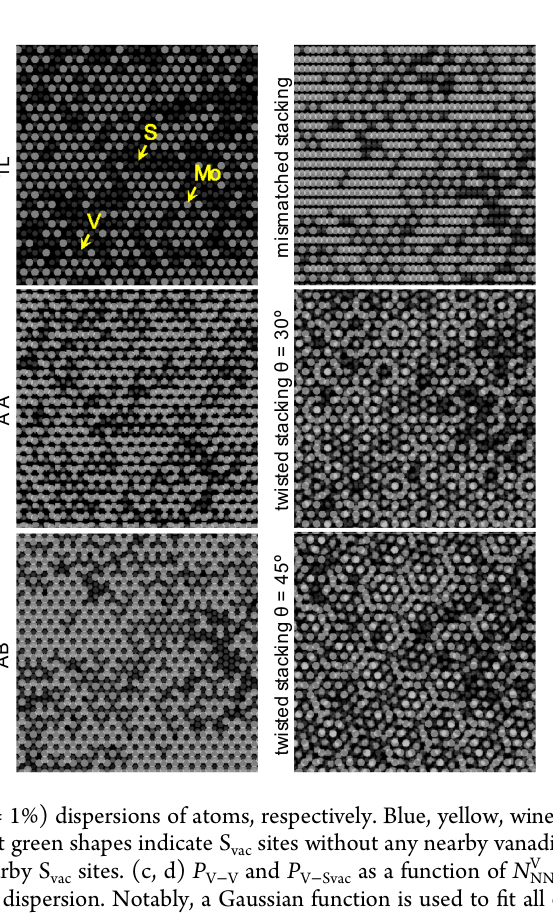
Figure 1: TEM images and elemental mapping of the V-Svac/MoS₂ heterostructure, showing the distribution of V, S, and Mo species in the composite catalyst.
Figure 2: CO₂ reduction performance including Faradaic efficiency and current density for the V-Svac/MoS₂ catalyst compared with pristine MoS₂ and V-Svac benchmarks.