← Back to Electrolysis Research
📄 Our Lab Paper

Electronic structure and defect density co-modulation of CoSe₂/CeO₂ nanocomposite for bifunctional hydrogen oxidation and reduction reactions

Materials Today Sustainability 26 (2024) 100695 | DOI: 10.1016/j.mtsust.2024.100695
Authors:Hamed Cheshideh, Guan-Cheng Chen, Hsin-Chih Huang, Chen-Hao Wang*

📄 Abstract

Developing bifunctional non-precious metal electrocatalysts toward hydrogen oxidation reaction (HOR) and hydrogen evolution reaction (HER) in acid is seriously challenged in various applications, such as hydrogen purifiers, fuel cells, and water electrolyzers. Here, we report the development of CoSe₂/CeO₂ nanocomposite electrocatalyst improved by electrochemical tuning for efficient HOR and HER in acid. Electrochemical tuning is shown to generate Ce³⁺, Co³⁺, and oxygen vacancies on the surface of the nanocomposite, which are considered as active sites for the adsorption and desorption of hydrogen species. The tuned catalyst (t-CoSe₂/CeO₂) indicates an impressive activity towards HOR and HER in 0.5 M H₂SO₄ solution, achieving an anodic current density of 1.8 mA cm⁻² at 900 rpm and a cathodic overpotential of 61 mV, respectively, outperforming the commercial Pt/C. Besides, the synthesized electrocatalyst delivers favorable HOR/HER durability. Our results suggest that the surface manipulation of CoSe₂/CeO₂ nanocomposite could provide promising insights for substituting precious electrocatalysts for HOR/HER.

🔬 Five Core Findings

1
Electrochemical tuning generates Ce³⁺, Co³⁺ and oxygen vacancies: Electrochemical tuning creates Ce³⁺, Co³⁺ ions and oxygen vacancy defects on the surface of CoSe₂/CeO₂ nanocomposite, which serve as active sites for hydrogen adsorption and desorption, fundamentally enhancing catalytic activity.
2
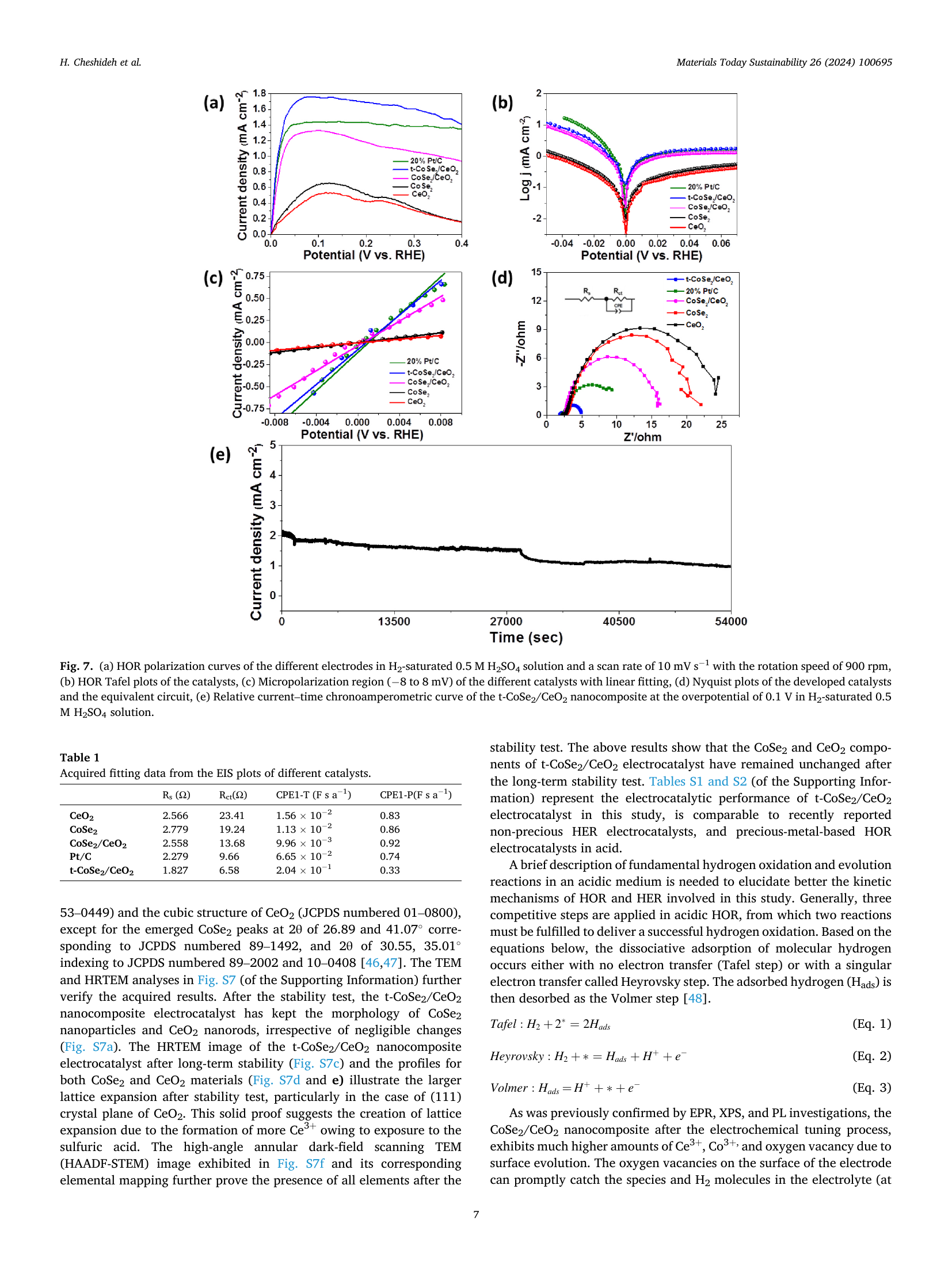
HOR activity surpasses commercial Pt/C: t-CoSe₂/CeO₂ achieves anodic current density of 1.8 mA cm⁻² at 900 rpm in 0.5 M H₂SO₄, outperforming commercial 20% Pt/C catalyst, demonstrating significantly improved HOR activity.
3
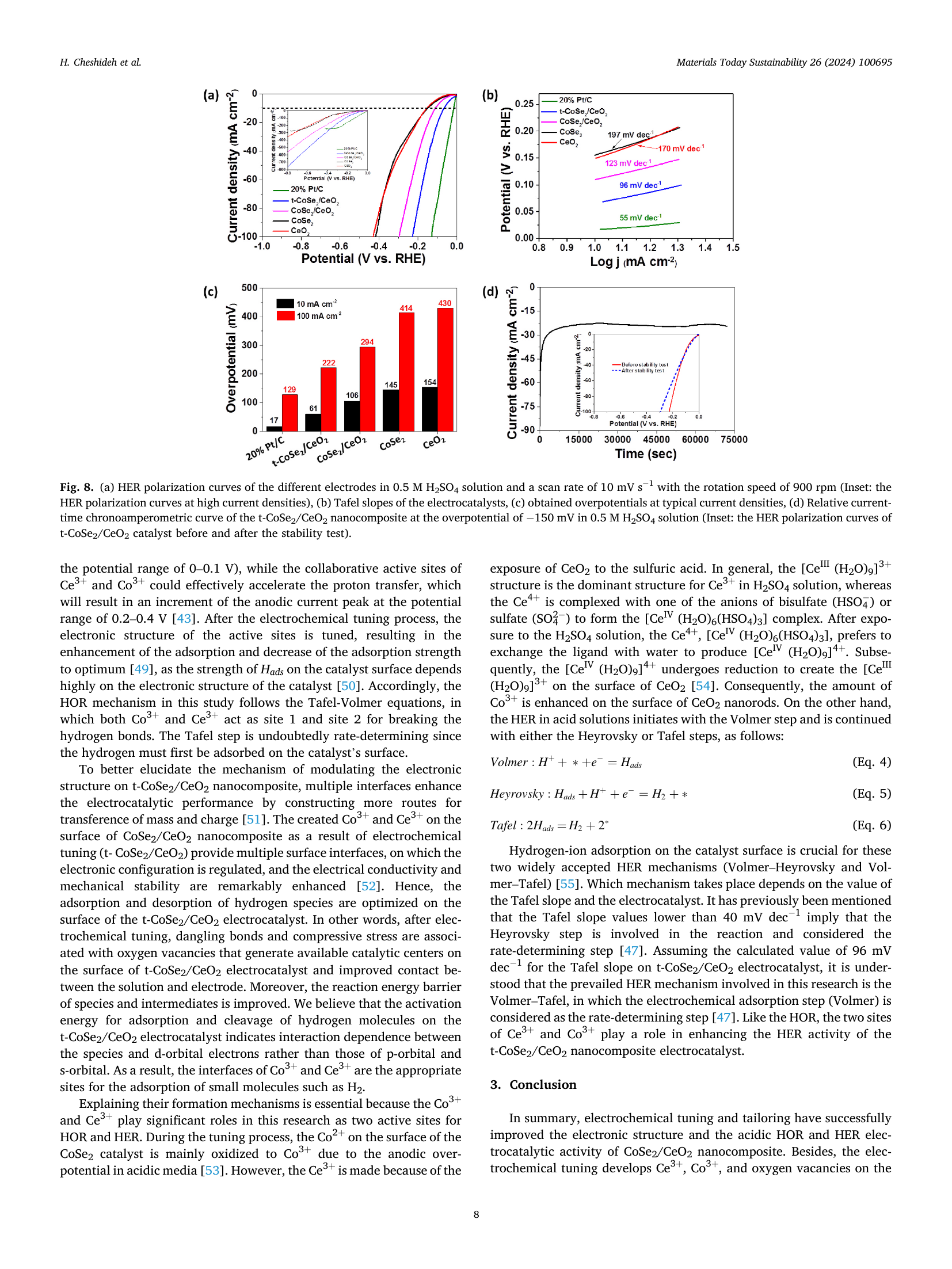
HER requires only 61 mV overpotential: t-CoSe₂/CeO₂ drives HER in acidic media with only 61 mV overpotential, superior to commercial Pt/C, exhibiting exceptional hydrogen evolution activity.
4
Co³⁺/Ce³⁺ interface multi-interfacial synergistic effect: The Co³⁺ and Ce³⁺ interfaces created by electrochemical tuning form multiple surface interfaces that enhance electrical conductivity and mechanical stability, optimizing hydrogen adsorption/desorption on t-CoSe₂/CeO₂ surface.
5
Pt-like bifunctional activity in acidic environment: t-CoSe₂/CeO₂ exhibits Pt-like bifunctional (HOR/HER) activity in acidic solution, providing a new research pathway for substituting Pt-based catalysts with non-precious metal alternatives.

📊 Key Figures

Key Figure 1: HOR electrochemical performance analysis, caption embedded in image.
Key Figure 2: HER electrochemical performance analysis, caption embedded in image.