← Back to Electrolysis Research
📄 Our Lab Paper

Electrodeposited barnacle-like phosphorized nickel–copper porous catalysts for oxygen evolution reaction

International Journal of Hydrogen Energy 128 (2025) 740–748 (Elsevier) | DOI: 10.1016/j.ijhydene.2025.04.266
Authors:Hsueh-Yu Chen, Guan-Cheng Chen, Hsin-Chih Huang, Chen-Hao Wang*

📄 Abstract

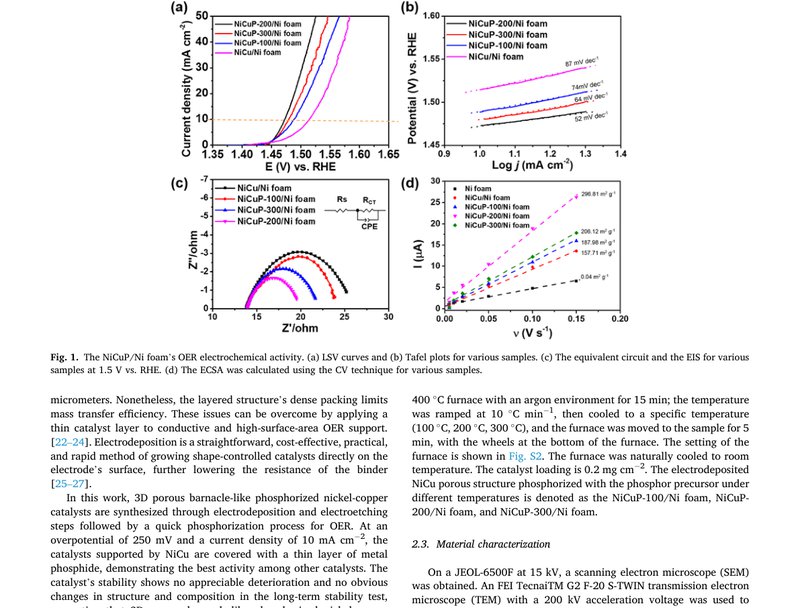
This work demonstrates the porous barnacle-like structure of NiCuP, which is co-electrodeposited on the nickel foam (NiCu/Ni foam) and does the phosphorization in a short time. Only the structure's surface can find phosphorus, which remains the conductivity of the nickel-copper and the porous structure (NiCuP-200/Ni foam). The catalysts show the overpotential of 250 mV for oxygen evolution reaction (OER) at the current density of 10 mA cm⁻². The cell using the NiCuP-200/Ni foam as the anode for the water electrolysis shows a highly consistent current density of about 180 mA cm⁻² at the cell potential of 1.8 V during 100 h operation. The phosphorization on the catalysts' surface helps the OER's activity. NiCuP-200/Ni foam remains porous after phosphorization, showing a high electrochemical surface area and low electrotransfer resistance.

🔬 Five Key Findings

1
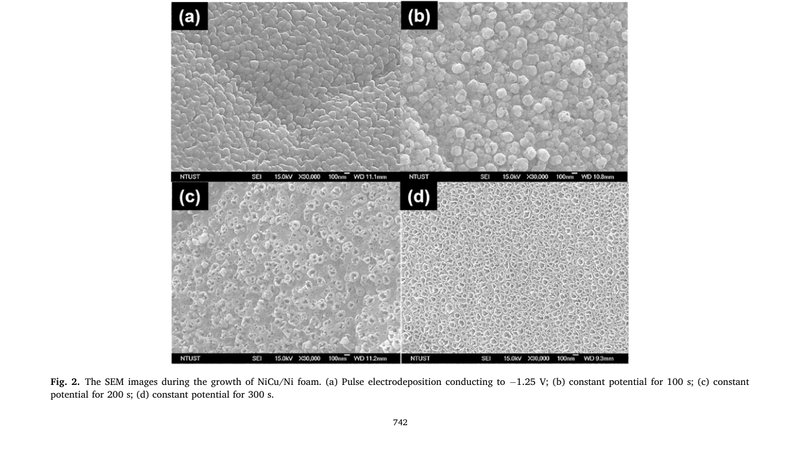
3D barnacle-like porous structure: Pulse electrodeposition combined with dealloying creates 3D barnacle-like porous NiCu on Ni foam (pore size ~50–100 nm), followed by brief phosphidation at 200°C for 5 min to form NiCuP-200/Ni foam.
2
Outstanding OER activity: NiCuP-200/Ni foam achieves only 250 mV overpotential at 10 mA cm⁻² with a Tafel slope of 52 mV dec⁻¹.
3
Exceptional long-term stability: Near-zero voltage degradation over 20 h at 10 mA cm⁻²; full-cell water electrolysis sustains ~180 mA cm⁻² at 1.8 V for 100 h.
4
Surface-only phosphorization preserves conductivity: Phosphorus localizes at the surface, maintaining the conductive NiCu metal core while enhancing surface OER activity.
5
Structural integrity preserved: Post-OER analysis confirms morphology remains intact; Ni retains phosphide form while Cu partially transforms to hydroxide — the synergy between metal and metal phosphide provides effective electron transport.

📊 Key Figures

Figure 1: The OER electrochemical activity of NiCuP/Ni foam catalysts at different phosphorization temperatures, showing polarization curves and Tafel analysis.
Figure 2: SEM images of NiCuP coatings deposited at different temperatures on Ni foam, revealing the evolution of barnacle-like porous morphology with treatment conditions.