← Back to Flow Battery Research
📄 Our Lab Paper

High-Entropy Oxide of (BiZrMoWCeLa)O₂ as a Novel Catalyst for Vanadium Redox Flow Batteries

ACS Applied Materials & Interfaces 2024, 16, 10019–10032 (ACS Publications) | DOI: 10.1021/acsami.3c15783
Authors:Aknachew Mebreku Demeku, Daniel Manaye Kabtamu*, Guan-Cheng Chen, Yun-Ting Ou, Zih-Jhong Huang, Ning-Yih Hsu, Hung-Hsien Ku, Yao-Ming Wang, and Chen-Hao Wang*

📄 Abstract

In this study, new fluorite high-entropy oxide (HEO), (BiZrMoWCeLa)O₂, nanoparticles were produced using a surfactant-assisted hydrothermal technique followed by calcination and were used as novel catalytic materials for vanadium redox flow batteries (VRFBs). The HEO calcined at 750 °C (HEO-750) demonstrates superior electrocatalytic activity toward V³⁺/V²⁺ and VO₂⁺/VO²⁺ redox couples compared to those of cells assembled with other samples. The charge−discharge tests further confirm that VRFBs using the HEO-750 catalyst demonstrate excellent Coulombic efficiency, voltage efficiency, and energy efficiency of 97.22, 87.47, and 85.04% at a current density of 80 mA cm⁻² and 98.10, 74.76, and 73.34% at a higher current density of 160 mA cm⁻², respectively. Moreover, with 500 charge−discharge cycles, there is no discernible degradation. These results are attributed to the calcination heat treatment, which induces the formation of a new single-phase fluorite structure, which facilitates the redox reactions of the vanadium redox couples. Furthermore, a high surface area, wettability, and plenty of oxygen vacancies can give more surface electroactive sites, improving the electrochemical performance, the charge transfer of the redox processes, and the stability of the VRFBs' electrode. This is the first report on the development of fluorite structure HEO nanoparticles in VRFBs, and it opens the door to further research into other HEOs.

🔬 Five Key Findings

1
First fluorite HEO for VRFB: This is the first report on fluorite-structured high-entropy oxide (BiZrMoWCeLa)O₂ nanoparticles as a catalyst for vanadium redox flow batteries, opening a new research direction for HEOs in flow batteries.
2
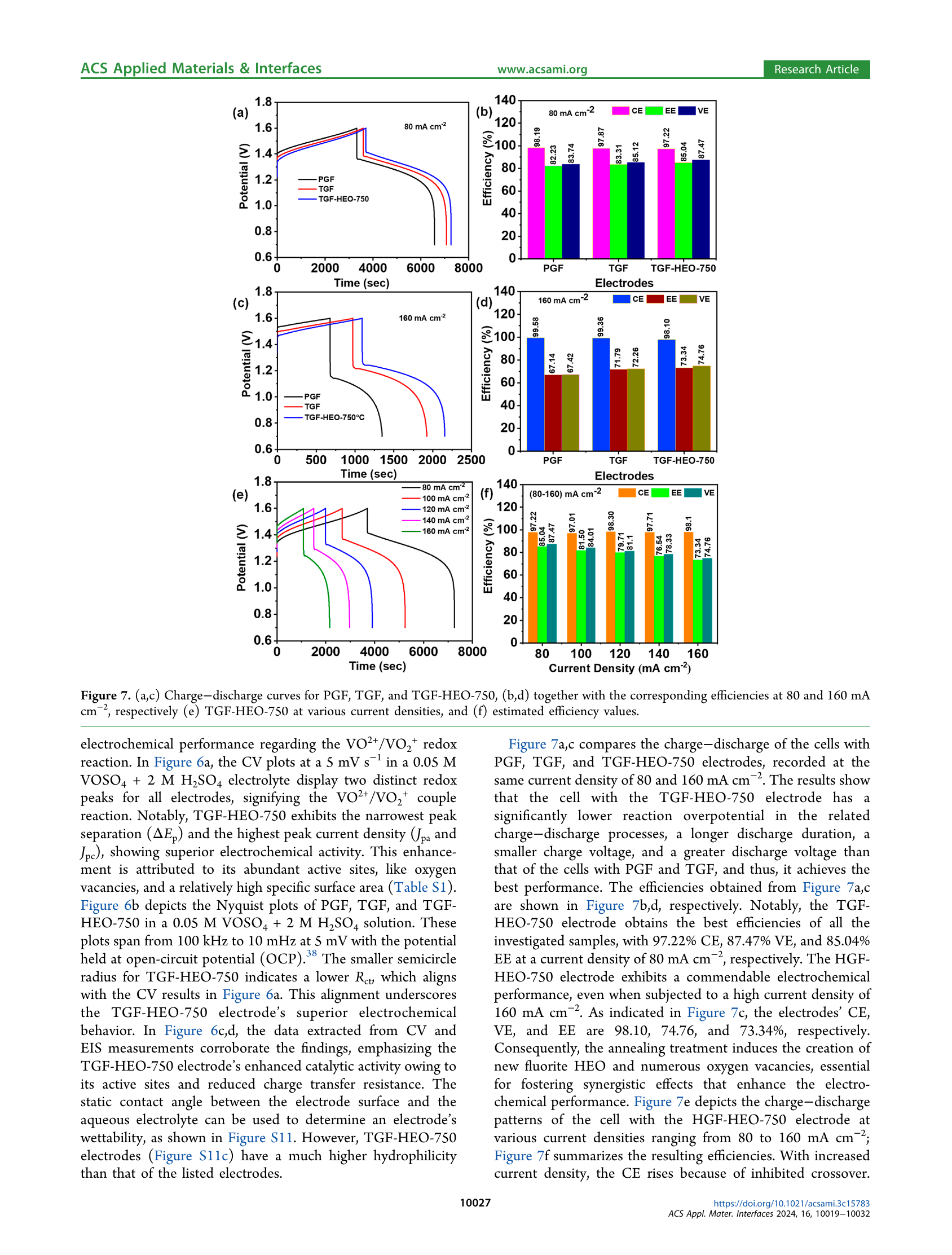
97.22% CE, 85.04% EE at 80 mA cm⁻²: The HEO-750 modified TGF electrode delivers excellent Coulombic efficiency (97.22%), voltage efficiency (87.47%), and energy efficiency (85.04%) at 80 mA cm⁻², outperforming bare PGF and TGF electrodes.
3
98.10% CE at 160 mA cm⁻²: Even at doubled current density, the HEO-750 catalyst maintains extremely high Coulombic efficiency (98.10%), demonstrating reliability under high-power operation conditions.
4
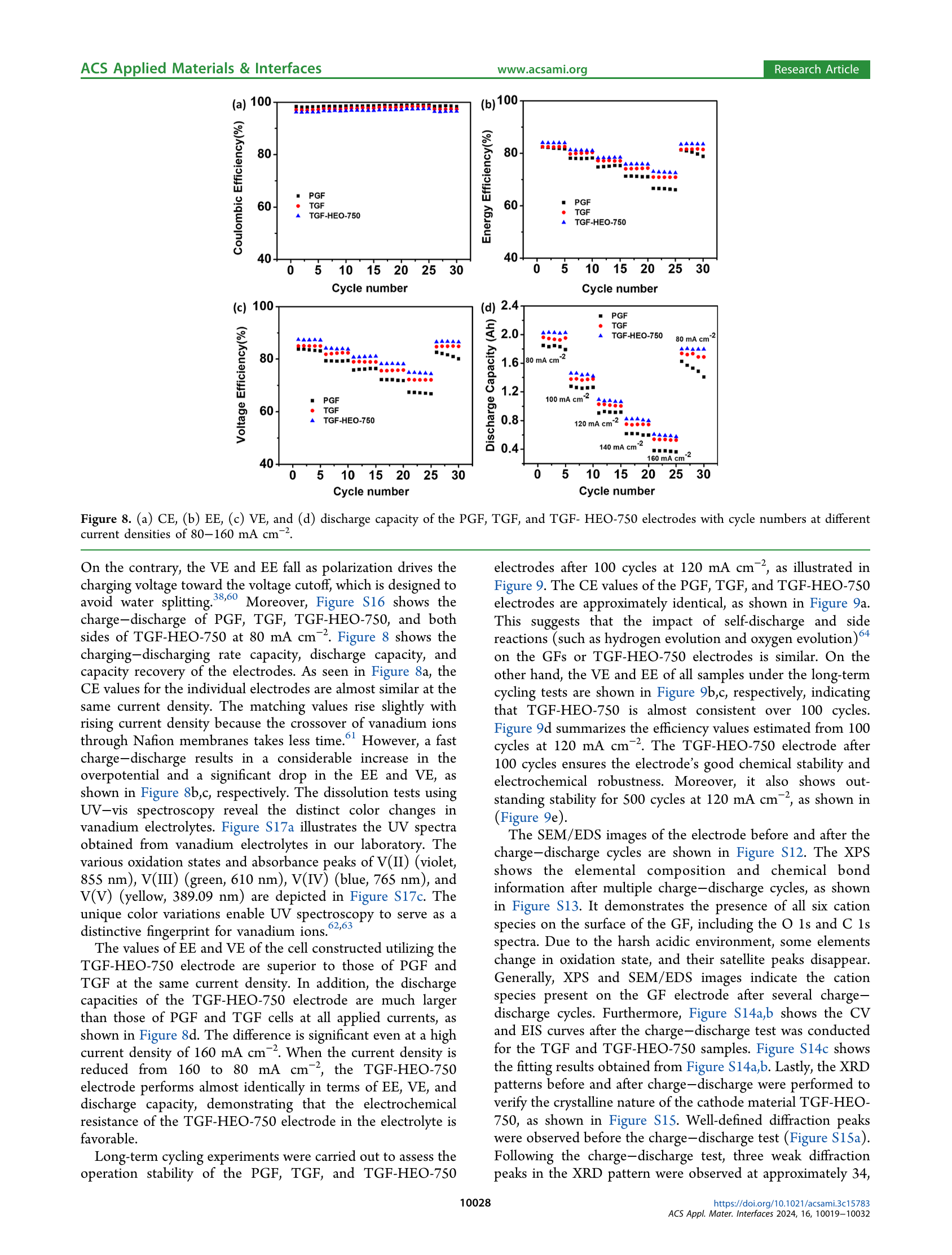
500 cycles with no significant degradation: Long-term charge-discharge cycling confirms exceptional durability of the HEO-750 modified electrode, providing a solid foundation for practical VRFB applications.
5
Single-phase fluorite + high surface area + oxygen vacancies: The calcination-induced single-phase fluorite structure, combined with high surface area, excellent wettability, and abundant oxygen vacancies, synergistically enhances redox kinetics and charge transfer.

📊 Key Figures

Figure 7: Charge-discharge curves and efficiency comparison of PGF, TGF, and TGF-HEO-750 at different current densities. (a, c, e) show charge-discharge curves; (b, d, f) show Coulombic efficiency (CE), energy efficiency (EE), and voltage efficiency (VE) bar charts.
Figure 8: Cycling stability test of PGF, TGF, and TGF-HEO-750. (a) Coulombic efficiency, (b) energy efficiency, (c) voltage efficiency vs. cycle number; (d) discharge capacity vs. cycle number at various current densities.