📄 Abstract
Redox flow batteries (RFBs) have attracted researchers due to their decoupled nature of energy and power modulations, suitability for large-scale stationary energy storage, and integration of renewable intermittent energy sources such as solar and wind power. Water's narrow electrochemical stability window limits the energy density of aqueous redox flow batteries. Thus, a shift to non-aqueous organic redox flow batteries (NAORFBs) is necessary to achieve high energy density while benefiting from organic solvents' expansive electrochemical stability windows. Nonetheless, the degradation and crossover of organic electroactive materials cause rapid capacity loss in NAORFBs. To improve the cycling stability of NAORFBs, molecular engineering is required to enhance the stability of redox-active species, particularly charged species, and the solubility of redox-active species. An appropriate ion-selective membrane that mitigates crossover by selectively allowing the passage of ions of supporting salts needs to be developed. This review discusses molecular design strategies that may improve radical ion stability, increase the solubility of redox-active species, and reduce redox-active species crossover and the selection of appropriate supporting electrolytes and separators/membranes for the overall enhancement of the cycle life and performance.
🔬 Five Core Findings
1
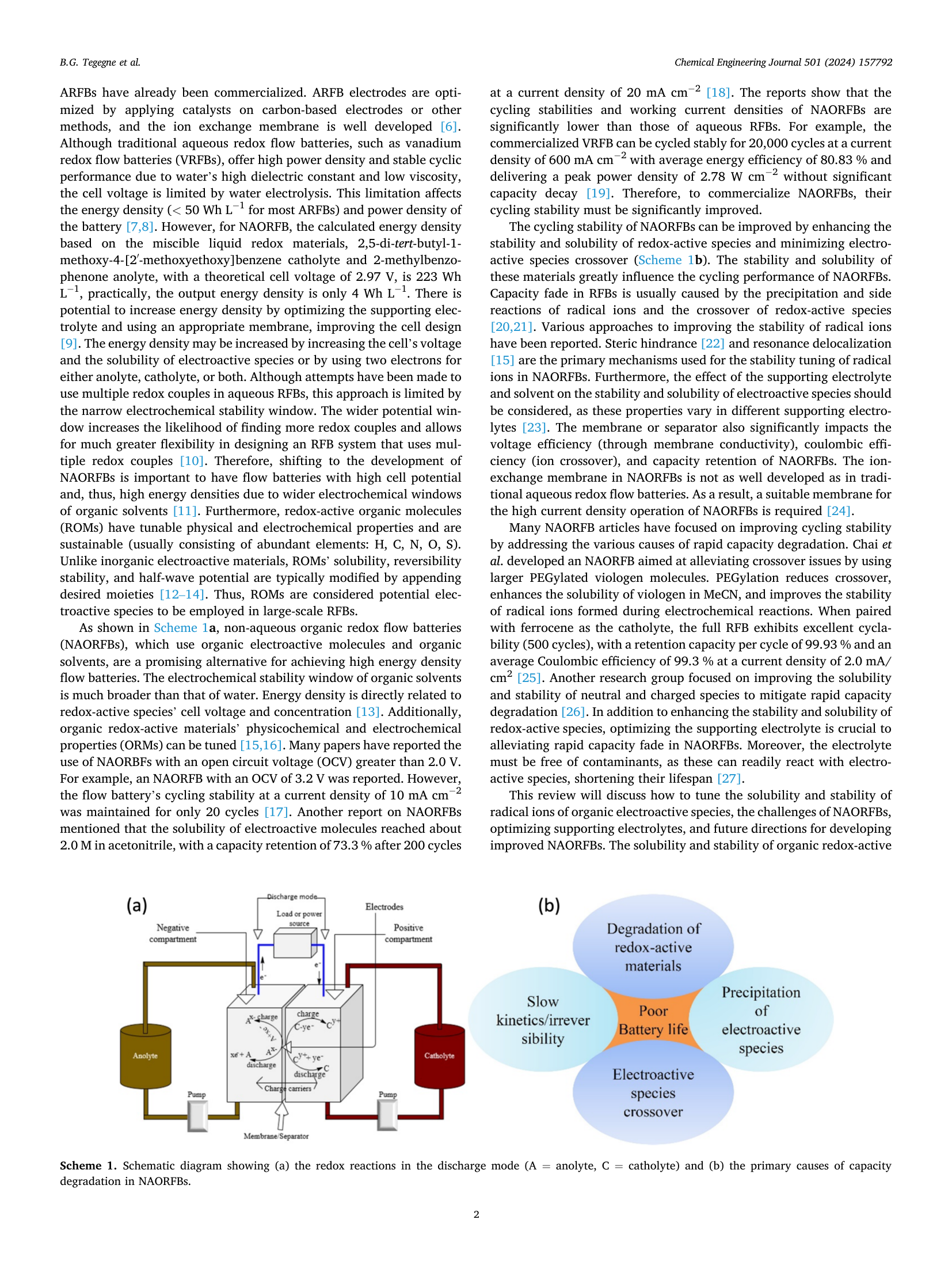
NAORFBs offer high energy density but face severe cycling stability challenges: While commercialized aqueous VRFBs achieve 20,000 cycles at 600 mA cm⁻² with 80.83% average energy efficiency, NAORFBs maintained only 20 cycles at 10 mA cm⁻². Theoretically, NAORFBs can reach 223 Wh L⁻¹ (e.g., with 2,5-di-tert-butyl-1-methoxy-4-[2′-methoxyethoxy]benzene catholyte and 2-methylbenzophenone anolyte, cell voltage 2.97 V), but practical output is only ~4 Wh L⁻¹ due to rapid capacity fade.
2
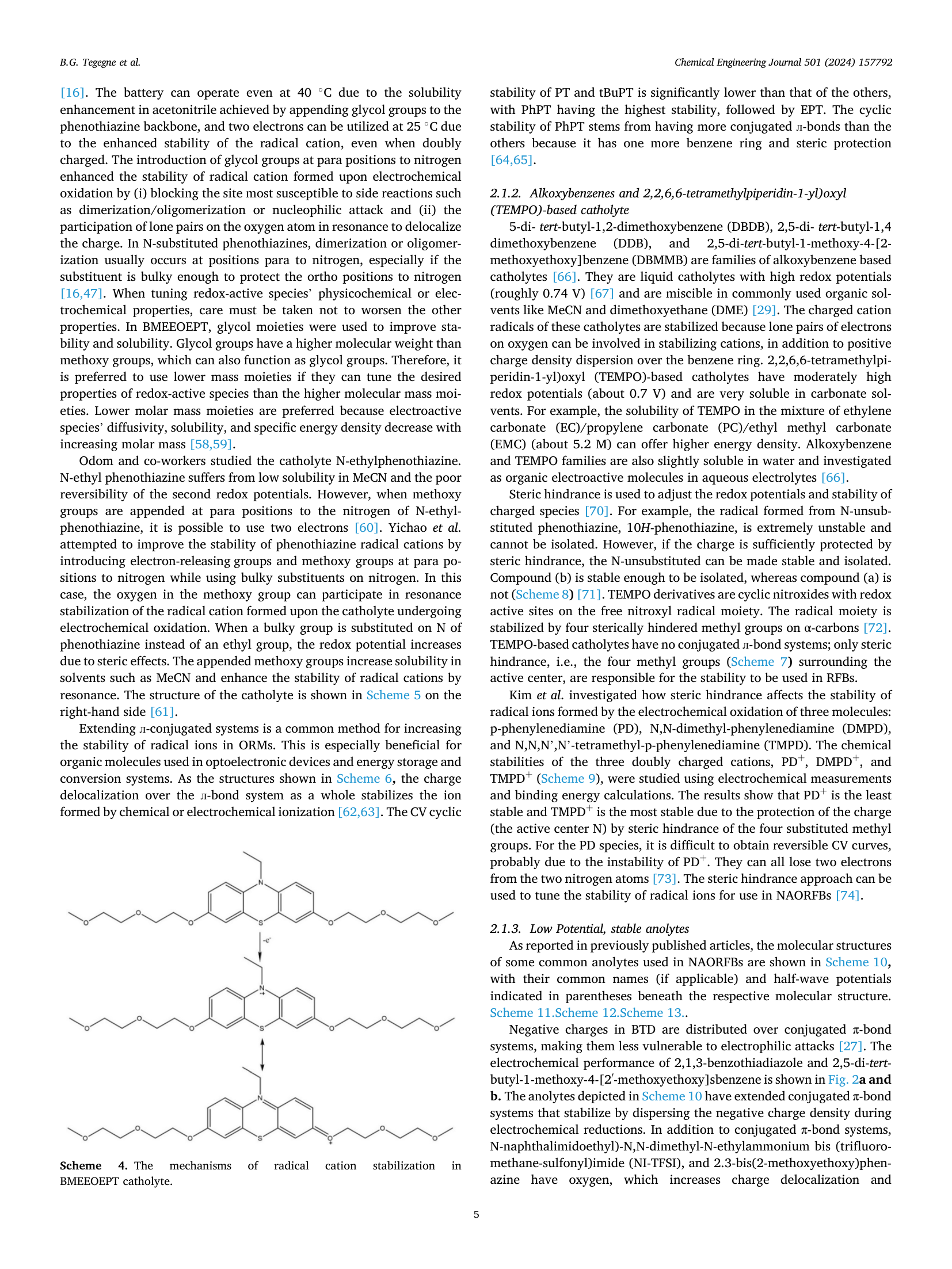
Strategy 1: Steric hindrance and resonance delocalization enhance radical ion stability: Introducing steric protection (bulky alkyl/phenyl substituents) prevents radical ion dimerization; resonance delocalization (methoxy, glycol substituents) stabilizes radical cations. PEGylated phenothiazine derivatives (e.g., BMEEOEPT) paired with ferrocene demonstrated 500 cycles at 2.0 mA cm⁻² with 99.93% capacity retention per cycle and 99.3% Coulombic efficiency.
3
Strategy 2: Substituent optimization improves solubility and redox potential: Appending alkyl/phenyl substituents at positions 3, 7, and 10 of phenothiazine enhances solubility and tunes half-wave potential (E1/2). Methoxy groups increase solubility and participate in resonance stabilization. Electron-withdrawing substituents raise catholyte redox potentials while electron-donating groups lower anolyte potentials.
4
Supporting electrolyte and membrane selection are critical: Common solvents: MeCN (viscosity 0.34 mPa s, window 6.3 V) and propylene carbonate (window 6.6 V, viscosity 2.53 mPa s). Supporting salts (TEABF₄, TBABF₄, TEATFSI) must fully dissolve redox-active species. Ion-exchange membranes provide 2× capacity retention compared to porous separators in NAORFBs.
5
Future directions: computational simulation (DFT) combined with experiments: Research should focus on developing stable, soluble, cost-effective redox-active molecules with high cell voltage and long cycle life, along with suitable ion-selective membranes and polar aprotic solvents that sustain solvation over long-term charge/discharge cycles.