← Back to Flow Battery Research
📄 Our Lab Paper

Nitrogen-doped carbonaceous electrode modified by biological metal-organic framework for vanadium redox flow batteries

Surface & Coatings Technology, 480 (2024) 130574 | DOI: 10.1016/j.surfcoat.2024.130574
Authors:Yun-Ting Ou, Daniel Manaye Kabtamu, Keseven Lakshmanan, Guan-Cheng Chen, Zih-Jhong Huang, Ning-Yih Hsu, Hung-Hsien Ku, Yao-Ming Wang, Chen-Hao Wang*

📄 Abstract

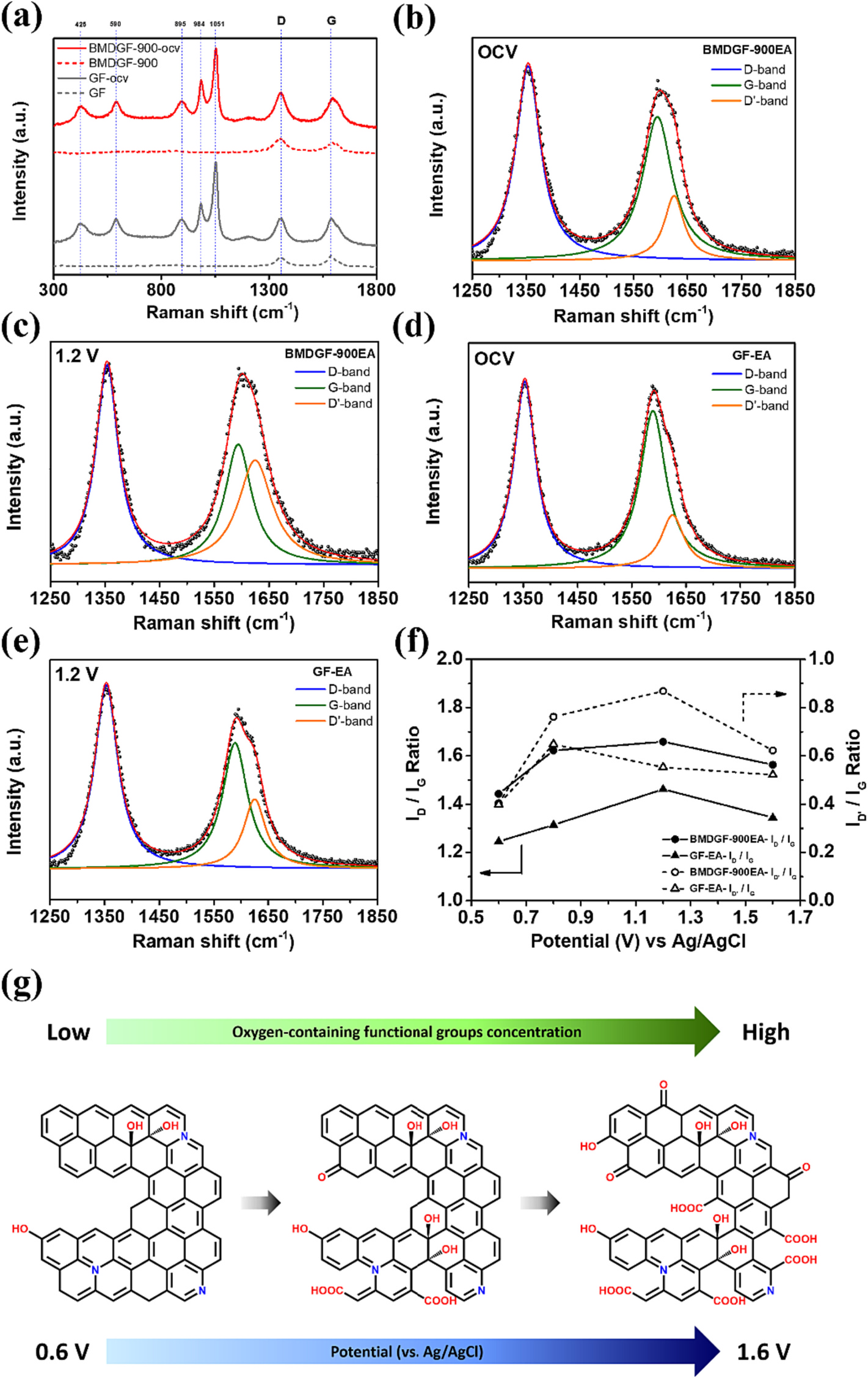
The biological metal-organic framework (Bio-MOF) is utilized to modify the carbonaceous electrode for the vanadium redox flow batteries. The microwave solvothermal method prepared the cobalt-based Bio-MOF on a graphite felt (GF) surface. Then, the nitrogen-doping graphite and porous structure formation were completed simultaneously during the carbonization process. Finally, electrochemical activation was conducted to remove cobalt metal from the GF electrode and raise the concentration of oxygen-containing functional group active sites. By in-situ Raman spectroscopy, the increase of disordered graphitic lattices could be observed by raising the potential from 0.6 V to 1.6 V. The microwave solvothermal method and electrochemical activation can effectively shorten the treatment time compared with the traditional solvothermal method and acidic etching processes. Among the carbonization parameters for Bio-MOF-covered GFs, maintaining the temperature at 900 °C for 2 h under an argon atmosphere is the most suitable. The annealed sample after electrochemical activation (BMDGF-900EA) displays 73.7 % energy efficiency at 120 mA cm⁻² and possesses a 90 % retention rate of efficiency after 250 cycles at 180 mA cm⁻². The superior performance results from more catalytic active sites, hydrophilic surface features, and larger specific surface area prove that this modification method derived from Bio-MOF indeed provides a novel and potential way to improve the VRFB performance.

🔬 Five Core Findings

1
Microwave solvothermal method with electrochemical activation significantly reduces modification time: Compared to traditional solvothermal and acid etching methods, microwave solvothermal (140°C, 1 h) dramatically shortens Bio-MOF preparation time; electrochemical activation selectively removes cobalt metal without strong acid while increasing oxygen-containing functional groups (especially C=O bond content increased from 7.7% for GF to 14.2%).
2
900°C carbonization is optimal parameter: Among 400-1000°C carbonization temperatures, 900°C, 2 h, argon atmosphere is optimal. XRD shows Co(II)O is carbothermally reduced to metallic Co at this temperature; 1000°C leads to excessive Co particle aggregation; SEM shows BMDGF-900 has appropriate pore structure and uniform distribution.
3
Electrochemical activation creates high porosity and hydrophilic surface: BMDGF-900EA specific surface area dramatically increased from 0.79 m²/g (pristine GF) to 2.52 m²/g. EDS elemental mapping confirms nitrogen is uniformly doped in graphite fibers, and electrochemical activation leaves only background Co signal, confirming complete Co removal.
4
BMDGF-900EA exhibits best electrochemical performance: CV tests show BMDGF-900EA has smallest peak potential separation (ΔEp = 470 mV) and Jpa/Jpc ratio of 1.35 closest to ideal value of 1; EIS shows charge transfer resistance (Rct = 18.93 Ω) far lower than GF-EA (51.38 Ω) and BMGF-EA (40.2 Ω).
5
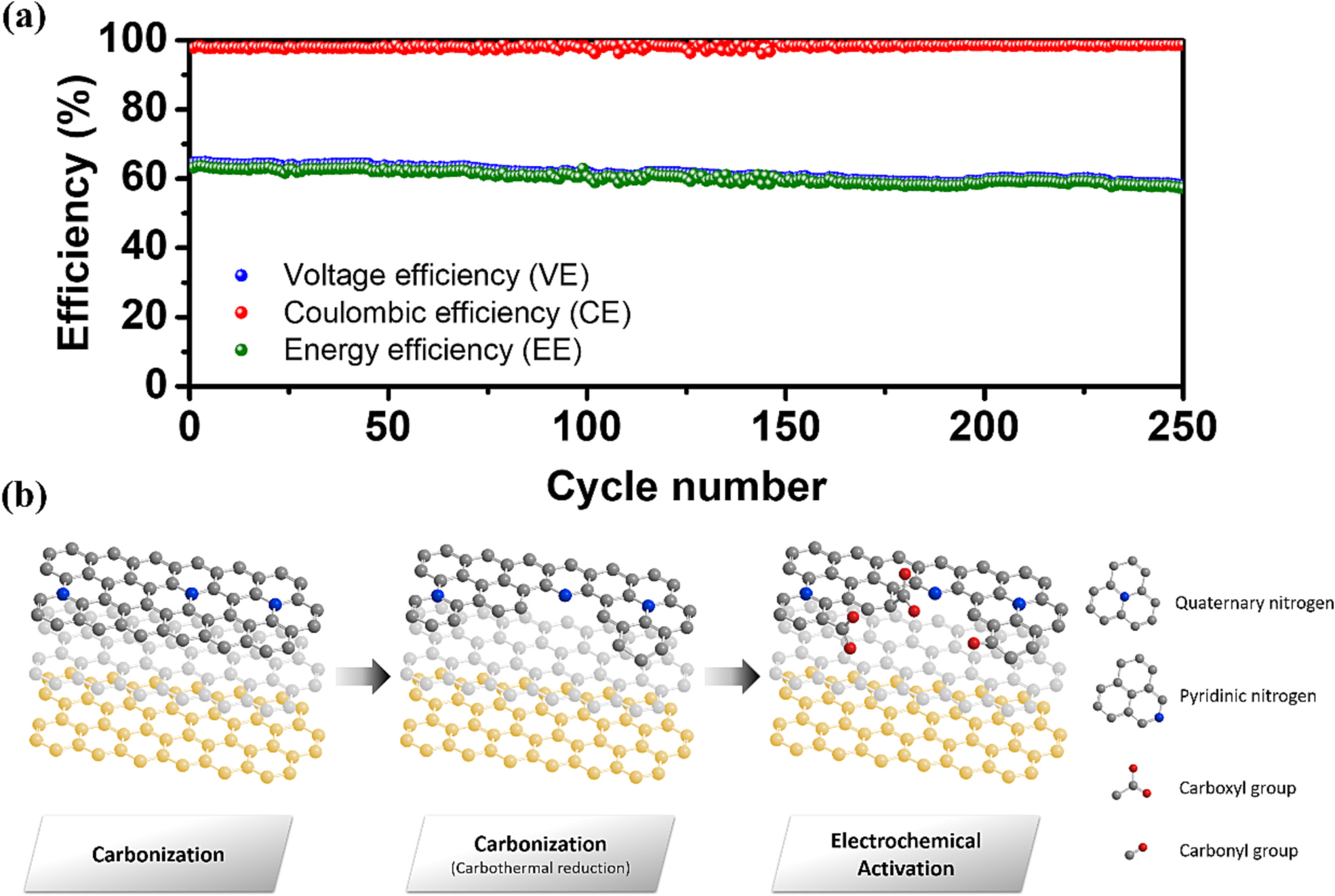
Excellent single-cell cycling stability: BMDGF-900EA achieves 73.7% energy efficiency at 120 mA/cm²; maintains 90% initial efficiency retention after 250 cycles at high current density of 180 mA/cm², validating long-term stability under actual VRFB operating conditions.

📊 Key Figures

Key Figure 1: Material preparation and structural analysis, caption embedded in image.
Key Figure 2: Electrochemical and stability analysis, caption embedded in image.