← Back to Flow Battery Research
📄 Our Lab Paper

Engineering high-entropy oxide on reduced graphene oxide as a highly stable and efficient electrocatalyst for vanadium redox flow batteries

Journal of Energy Storage, 141 (2026) 119119 (Elsevier) | DOI: 10.1016/j.est.2025.119119
Authors:Aknachew Mebreku Demeku, Daniel Manaye Kabtamu, Anteneh Wodaje Bayeh, Krishnakant Tiwari, Zih-Jhong Huang, Ning-Yih Hsu, Hung-Hsien Ku, Sun-Tang Chang, Ying-Rui Lu, Chen-Hao Wang*

📄 Abstract

Efficient catalysts are essential for vanadium redox flow batteries (VRFBs), a key technology for large-scale energy storage. We report a high-entropy oxide of (CeMoBiWZrLa)O₂ supported by reduced graphene oxide ((CeMoBiWZrLa)O₂/rGO) as a composite catalyst for enhanced VRFB performance. The composite, synthesized via a hydrothermal reduction process, consists of dispersed HEO nanoparticles anchored on rGO sheets, which enhances electrolyte wettability and improves performance by enabling faster kinetics and more efficient ion transport. Moreover, the high configurational entropy, abundant oxygen vacancies, and inherent mechanical stability of HEO synergistically facilitate ion desorption, ensuring long-term durability. In-situ Raman spectroscopy reveals M–OH and C–OH₂⁺ intermediates, confirming accelerated redox kinetics in acidic electrolytes. The HEO/rGO-modified HGF electrode achieves energy efficiencies of 85.75% and 80.22% at 80 and 120 mA cm⁻² (improvements of 7.44% and 13.36%, respectively), with excellent stability over 300 cycles.

🔬 Five Key Findings

1
85.75% EE at 80 mA cm⁻²: A 7.44% improvement over bare HGF, demonstrating excellent catalytic performance of high-entropy oxides for VRFB positive electrodes.
2
80.22% EE at 120 mA cm⁻²: A 13.36% improvement, maintaining high efficiency even at elevated current density.
3
Stable over 300 cycles: Demonstrating excellent long-term durability and reliability under actual VRFB operating conditions.
4
In-situ Raman evidence: M–OH and C–OH₂⁺ intermediates confirm accelerated redox kinetics in acidic electrolytes, providing direct evidence of reaction mechanism.
5
High configurational entropy + oxygen vacancies + mechanical stability: Triple advantage synergistically facilitates ion desorption for long-term stability and excellent cycling performance.

📊 Key Figures

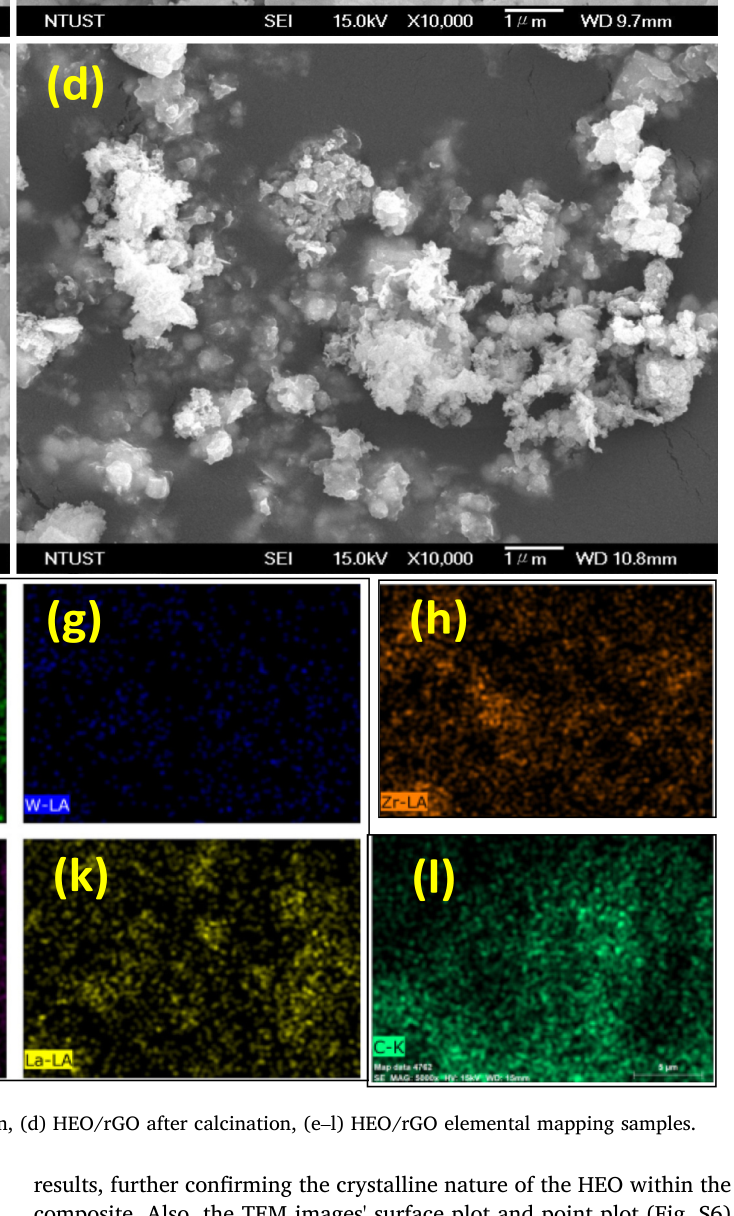
Key Figure 1: FE-SEM images comparing the morphology of pristine rGO foam versus HEO nanoparticle-decorated rGO, showing significant structural differences after HEO loading.
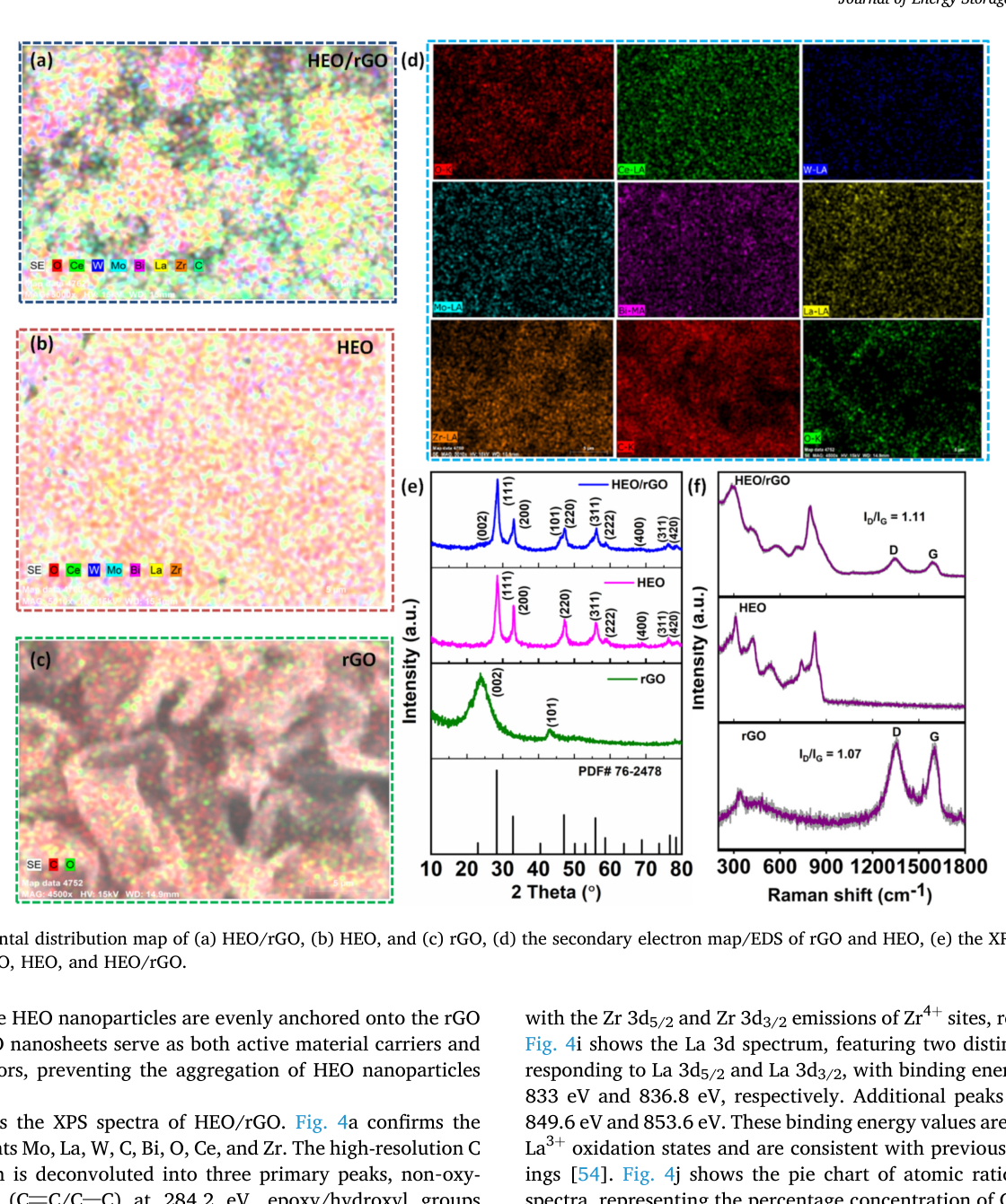
Key Figure 2: Elemental distribution maps (EDS) of HEO/rGO composite, confirming the spatial distribution of high-entropy oxide nanoparticles on the graphene framework.