← Back to Flow Battery Research
📄 Our Lab Paper

Engineering defect-rich high-entropy (CrMnFeCoNi)₃O₄/rGO nanocomposites for high-performance vanadium redox flow batteries

Journal of Power Sources, 666 (2026) 239082 (Elsevier) | DOI: 10.1016/j.jpowsour.2025.239082
Authors:Aknachew Mebreku Demeku, Yu-Ling Wang, Daniel Manaye Kabtamu, Hailegnaw Gizaw Workie, Anteneh Wodaje Bayeh, Zih-Jhong Huang, Ning-Yih Hsu, Hung-Hsien Ku, Yao-Ming Wang, Chen-Hao Wang*

📄 Abstract

High-entropy spinel oxide (CrMnFeCoNi)₃O₄ has emerged as a promising electrode material for vanadium redox flow batteries (VRFBs). In this work, a spinel-structured (CrMnFeCoNi)₃O₄/reduced graphene oxide (rGO) nanocomposite was synthesized via a hydrothermal process followed by thermal reduction. The (CrMnFeCoNi)₃O₄ nanoparticles on rGO produce a strong synergistic effect, providing abundant redox-active sites and fast ion transport to enhance charge-transfer kinetics, reversibility, and stability. EXAFS analysis revealed a disordered local structure with reduced coordination and slight bond shifts, indicating that lattice distortion and oxygen vacancies reinforce defect stability. The (CrMnFeCoNi)₃O₄/rGO-modified electrode achieved a high energy efficiency of 87.14% at 80 mA cm⁻² and maintained excellent stability over 300 cycles at 200 mA cm⁻².

🔬 Five Key Findings

1
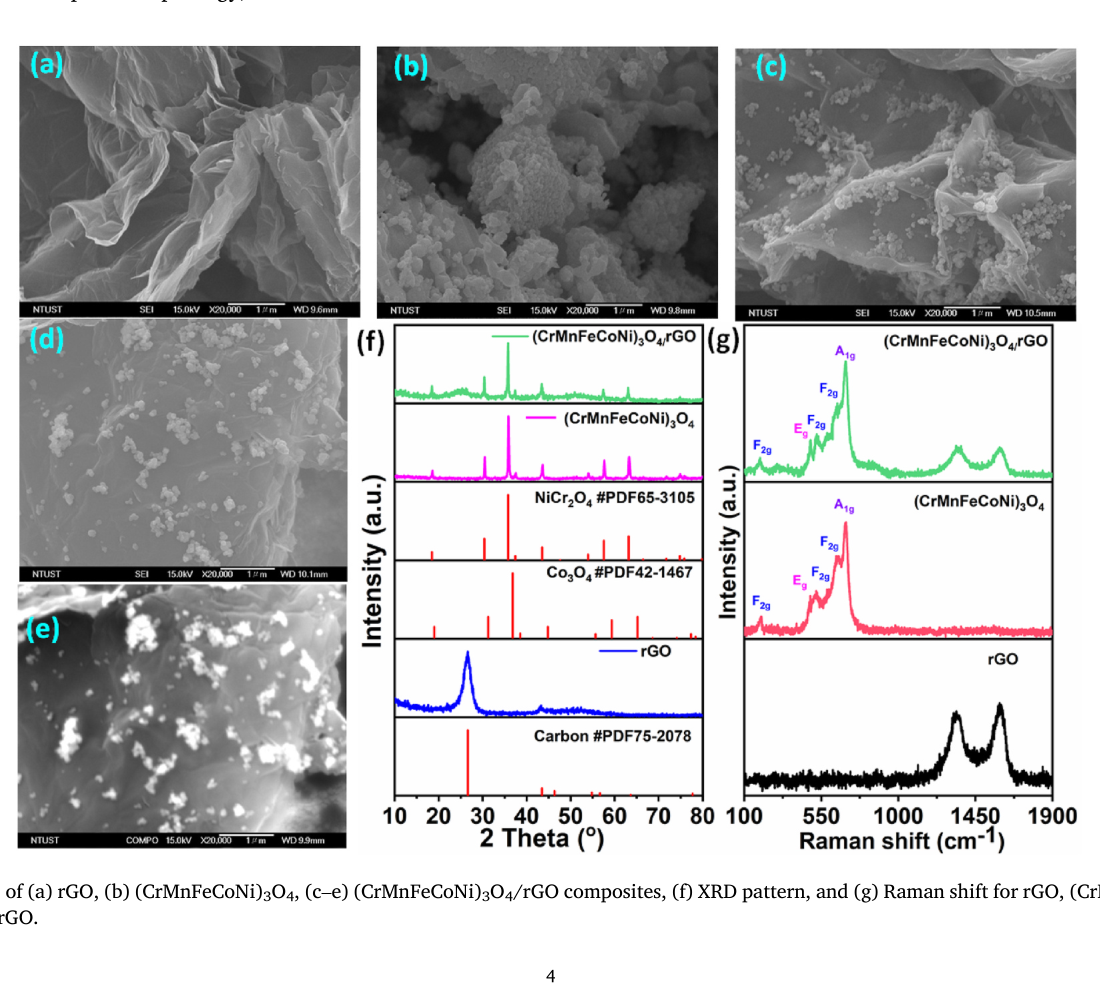
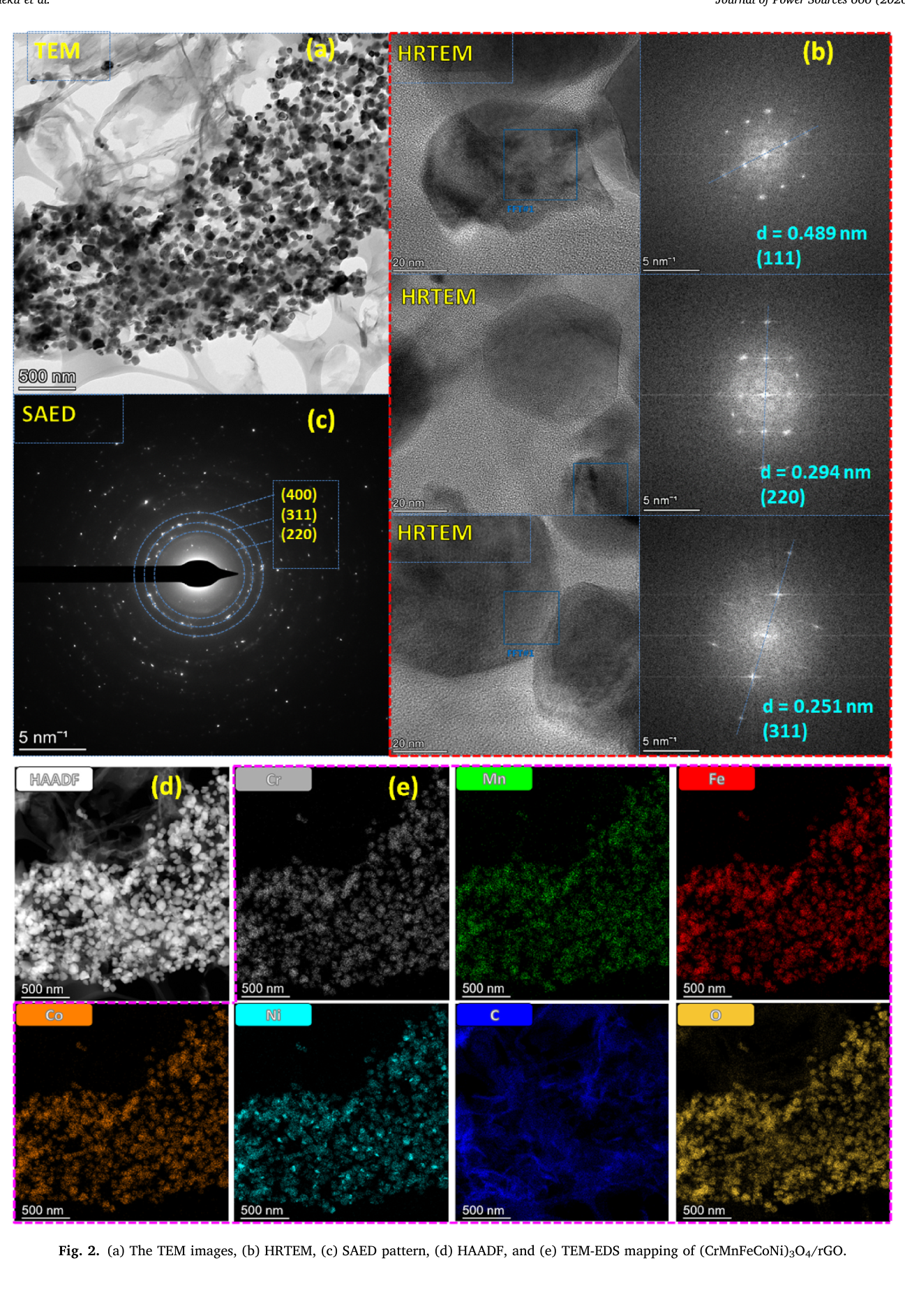
rGO + HEO synergistic effect: Nanoparticles uniformly distributed on rGO surface, providing abundant redox-active sites, accelerating ion transport, and reducing charge-transfer impedance.
2
EXAFS confirms defect engineering: Lattice distortion and oxygen vacancies interact synergistically with reduced coordination and bond length shifts, enhancing defect stability.
3
87.14% EE at 80 mA cm⁻²: 8.07% higher than unmodified HGF, demonstrating excellent catalytic performance of high-entropy oxides for VRFB positive electrodes.
4
300-cycle stability at 200 mA cm⁻²: Only 0.053% capacity decay per cycle, demonstrating exceptional long-term cycling durability.
5
ICP-OES confirms minimal leaching: Cr and Mn undetected, Fe/Co/Ni < 0.025 ppm after 200 CV cycles, confirming excellent material stability.

📊 Key Figures

Key Figure 1: SEM images of rGO nanosheets showing characteristic wrinkled thin-film structure, facilitating ion transport and increased electrochemical active surface area.
Key Figure 2: TEM images of (CrMnFeCoNi)₃O₄/rGO composite revealing uniform high-entropy oxide nanoparticle loading on graphene support with excellent interfacial contact.