Molybdenum-doped NiCo₂O₄ nanowires with enriched oxygen vacancies for wide-current-density VRFBs
📄 Abstract
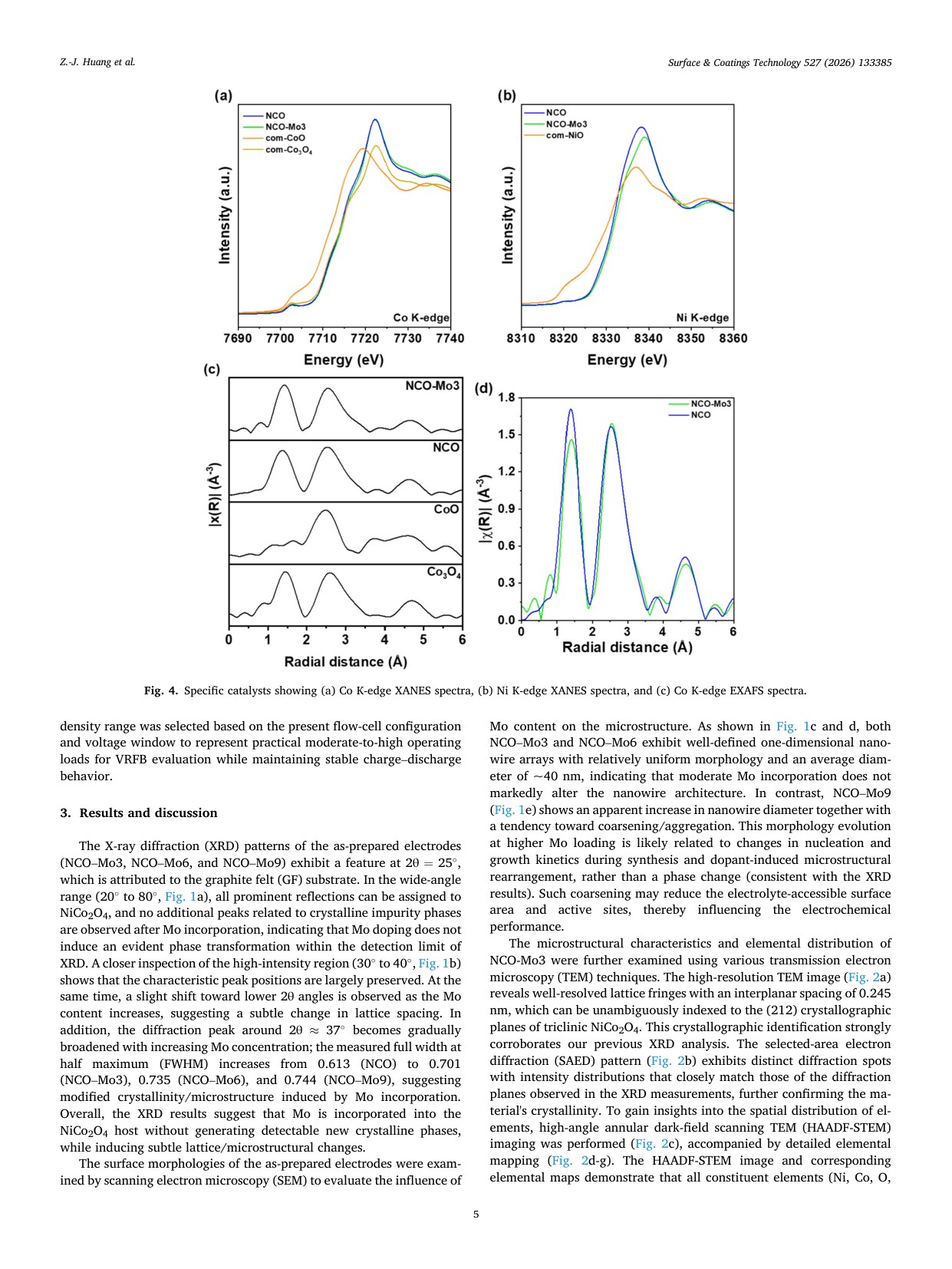
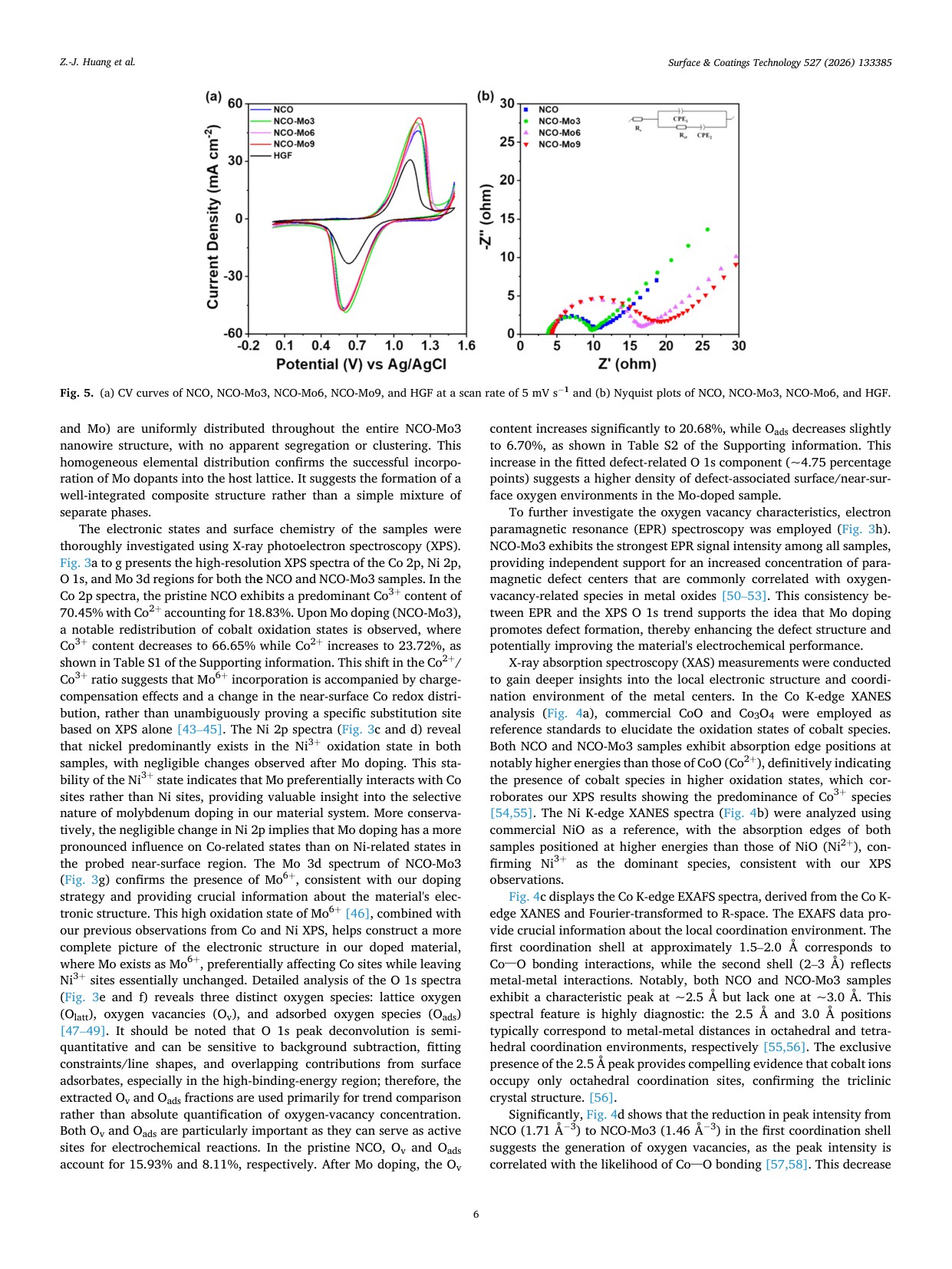
Molybdenum-doped nickel–cobalt oxide (NCO–Mo) nanowires were directly grown on graphite felt to construct high-performance electrodes for vanadium redox flow batteries (VRFBs). Morphological and structural characterizations (XRD, HAADF-STEM, XPS, XANES, and EXAFS) confirm a well-integrated nanowire coating with uniform elemental distribution and Mo incorporation into the NiCo₂O₄ host without detectable crystalline impurity phases. Mo incorporation induces oxygen vacancies (+4.75 percentage points) and modulates near-surface electronic states, which are expected to benefit interfacial charge transfer and provide abundant active sites for vanadium redox reactions. Electrochemical tests demonstrate that the optimized NCO–Mo₃ electrode delivers an energy efficiency of 86.96% at 80 mA cm⁻², 12.3 percentage points higher than pristine graphite felt (74.68%). Notably, it maintains strong performance over a wide current-density range (80–260 mA cm⁻²), achieving 63.46% efficiency at the maximum current density. The electrode also exhibits excellent durability over 250 charge–discharge cycles with coulombic efficiency above 97% and negligible performance decay (<0.2% per cycle). Mechanistically, oxygen-vacancy-mediated defect engineering reduces charge-transfer resistance, suppresses hydrogen evolution, and enhances intrinsic catalytic activity toward the VO₂⁺/VO²⁺ redox reactions.
🔬 Five Key Findings
📊 Key Figures