← Back to Fuel Cell Research
🤝 Collaborative Paper

Potential synergy between Pt₂Ni₄ Atomic-Clusters, oxygen vacancies and adjacent Pd nanoparticles outperforms commercial Pt nanocatalyst in alkaline fuel cells

Chemical Engineering Journal 483 (2024) 149421 | DOI: 10.1016/j.cej.2024.149421
Authors:Dinesh Bhalothia, Amisha Beniwal, Che Yan, Kai-Chin Wang, Chen-Hao Wang, Tsan-Yao Chen*

📄 Abstract

The oxygen reduction reaction (ORR) is a key "showstopper" for the commercial viability of alkaline fuel cells (AFCs). In this study, we developed a ternary nanocatalyst (NC) coloaded with Pt₂Ni₄ atomic clusters and palladium (Pd) nanoparticles (NPs) on oxygen vacancies (OVs) enriched nickel hydroxide-support (henceforth denoted as NiPP). This material outperforms the commercial J.M.-Pt/C (20 wt%) catalyst by ~75 and ~38 times with exceptionally high mass activities (MA)s of 5050.3 mAmg⁻¹Pt and 952.3 mAmg⁻¹Pt at 0.85 V and 0.90 V vs RHE, respectively, in alkaline ORR (0.1 M KOH). The high structural reliability of the Pt₂Ni₄ endows the NiPP NC with outstanding durability, where it achieves an optimum MA of 5755.9 mAmg⁻¹Pt after 10 K cycles in an accelerated durability test (ADT) and retains the original performance up to 15 K cycles. Moreover, NiPP delivers an outstanding power density (339.1 mW cm⁻²) and short circuit current density (910.8 mA cm⁻²), which exceeds the commercial J.M.-Pt/C (174.9 mW cm⁻² and 720.4 mA cm⁻²) when serving as the cathodic catalyst in an AFC. The results suggest that the exceptional performance originates from the potential synergism between the neighbouring reaction sites of Pt₂Ni₄ (OV in Ni(OH)x and Pd NPs). During ORR, the Pt₂Ni₄ atomic clusters and OVs boost the O₂ splitting, while the adjacent Pd NPs promote the subsequent relocation of OH⁻ ions.

🔬 Five Core Findings

1
Mass activity 38–75× higher than commercial Pt/C: NiPP achieves 5050.3 mAmg⁻¹Pt at 0.85 V vs RHE and 952.3 mAmg⁻¹Pt at 0.90 V vs RHE in 0.1 M KOH, ~75× and ~38× better than commercial J.M.-Pt/C (20 wt%), demonstrating exceptionally high Pt utilization.
2
Retains 100% original performance up to 15,000 cycles: NiPP achieves optimum MA of 5755.9 mAmg⁻¹Pt after 10,000 ADT cycles and fully retains original performance through 15,000 cycles, far superior to commercial Pt/C.
3
Peak power density of 339.1 mW cm⁻² surpasses commercial standard: As AFC cathode catalyst, NiPP delivers power density of 339.1 mW cm⁻² and short circuit current density of 910.8 mA cm⁻², both exceeding commercial J.M.-Pt/C (174.9 mW cm⁻², 720.4 mA cm⁻²).
4
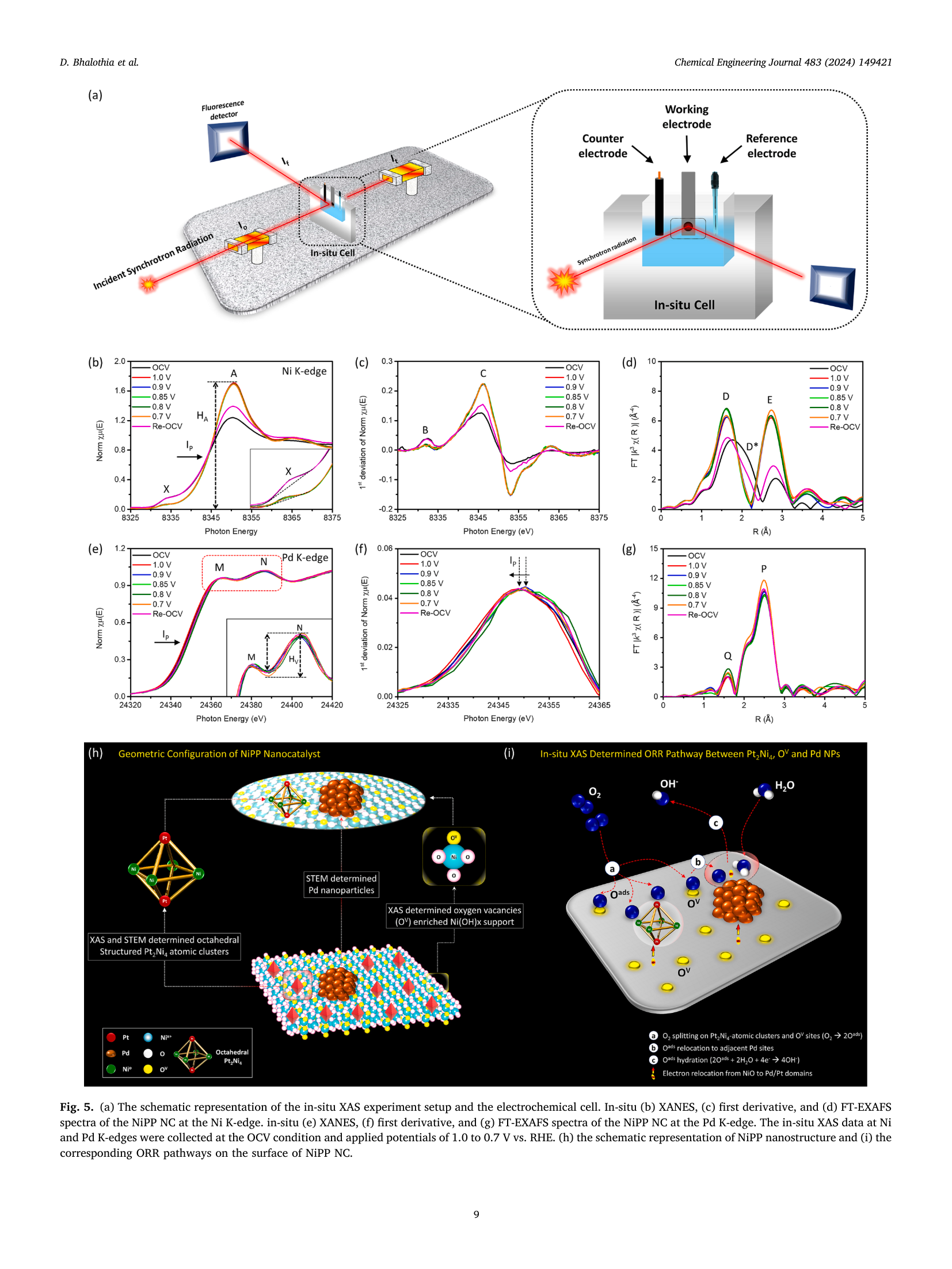
Ternary synergistic mechanism: Pt₂Ni₄ + OV + Pd NPs: The NiPP NC consists of Pt₂Ni₄ atomic clusters adjacent to Pd nanoparticles on OV-enriched Ni(OH)ₓ support. Pt₂Ni₄ clusters and OVs boost O₂ splitting while adjacent Pd atoms favor subsequent OH⁻ relocation, synergistically accelerating ORR kinetics.
5
In-situ XAS confirms structural reliability: Operando X-ray absorption spectroscopy confirms that NiPP maintains its electronic structure and bonding environment under potential-driven conditions, providing atomic-level evidence for long-term operational stability.

📊 Key Figures

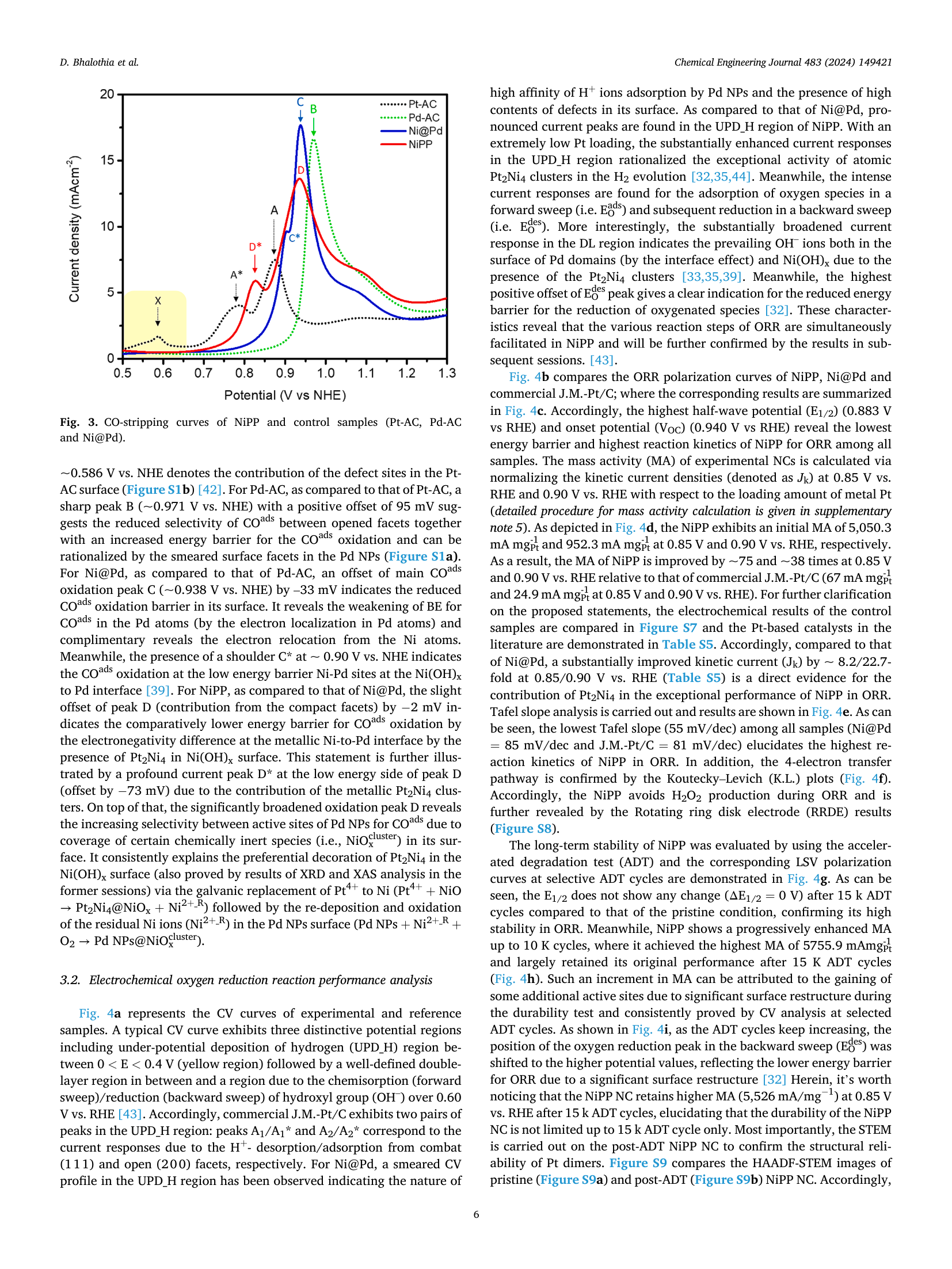
Key Figure 1: Electrochemical performance analysis, caption embedded in image.
Key Figure 2: In-situ XAS structural analysis and ORR reaction mechanism schematic, caption embedded in image.