← Back to Fuel Cell Research
📄 Our Lab Paper

MOF-199-Based Nitrogen-Doped Bimetal Cathode Catalyst for Anion Exchange Membrane Fuel Cells

ACS Applied Energy Materials, 7 (2024) 10960–10970 | DOI: 10.1021/acsaem.4c01926
Authors:Afandi Yusuf, Yusuf Pradesar, Guan-Cheng Chen, Hsin-Chih Huang, and Chen-Hao Wang*

📄 Abstract

Anion exchange membrane fuel cells (AEMFCs) face significant challenges in developing cost-effective and high-performance cathode catalysts for the oxygen reduction reaction (ORR). This study reports a MOF-199-derived nitrogen-doped bimetal (Cu/Fe) carbon-based catalyst (PSM-199-900-AL) as a promising non-precious metal cathode catalyst for AEMFCs. The optimal thermal treatment at 900 °C yields a catalyst with exceptional ORR activity in alkaline media, achieving an onset potential of 0.99 V, a half-wave potential of 0.846 V, and a near-four-electron transfer pathway (n = 3.997). The Cu2+/Fe0 dual active sites work cooperatively: Fe activates O₂ while Cu facilitates intermediate desorption, synergistically enhancing ORR kinetics. When evaluated in an AEMFC, PSM-199-900-AL delivers a peak power density of 352.2 mW/cm², comparable to commercial Pt/C (381.9 mW/cm²). Moreover, the catalyst demonstrates outstanding durability with only a 30 mV half-wave potential loss after 30,000 cycles. This work highlights the great potential of MOF-derived bimetal catalysts as efficient and stable cathode materials for next-generation AEMFCs.

🔬 Five Core Findings

1
Near-four-electron ORR pathway (n = 3.997): PSM-199-900-AL achieves onset potential of 0.99 V and half-wave potential of 0.846 V in 0.1 M KOH, with electron transfer number n ≈ 3.997, approaching ideal four-electron transfer and reducing H₂O₂ yield to <1%.
2
Cu²⁺/Fe⁰ dual active site synergy: Fe activates O₂ (provides active sites) while Cu facilitates intermediate desorption, synergistically enhancing ORR kinetics. First detailed mechanism revealing Cu-Fe synergy in MOF-derived bimetallic catalysts.
3
AEMFC peak power density of 352.2 mW/cm²: PSM-199-900-AL with Nafion211 membrane achieves peak power density of 352.2 mW/cm², comparable to commercial Pt/C (381.9 mW/cm²), demonstrating practical potential.
4
30,000-cycle durability test: PSM-199-900-AL shows only 30 mV half-wave potential loss after 30,000 accelerated durability test cycles, far superior to Pt/C's 68 mV degradation, demonstrating excellent catalytic stability.
5
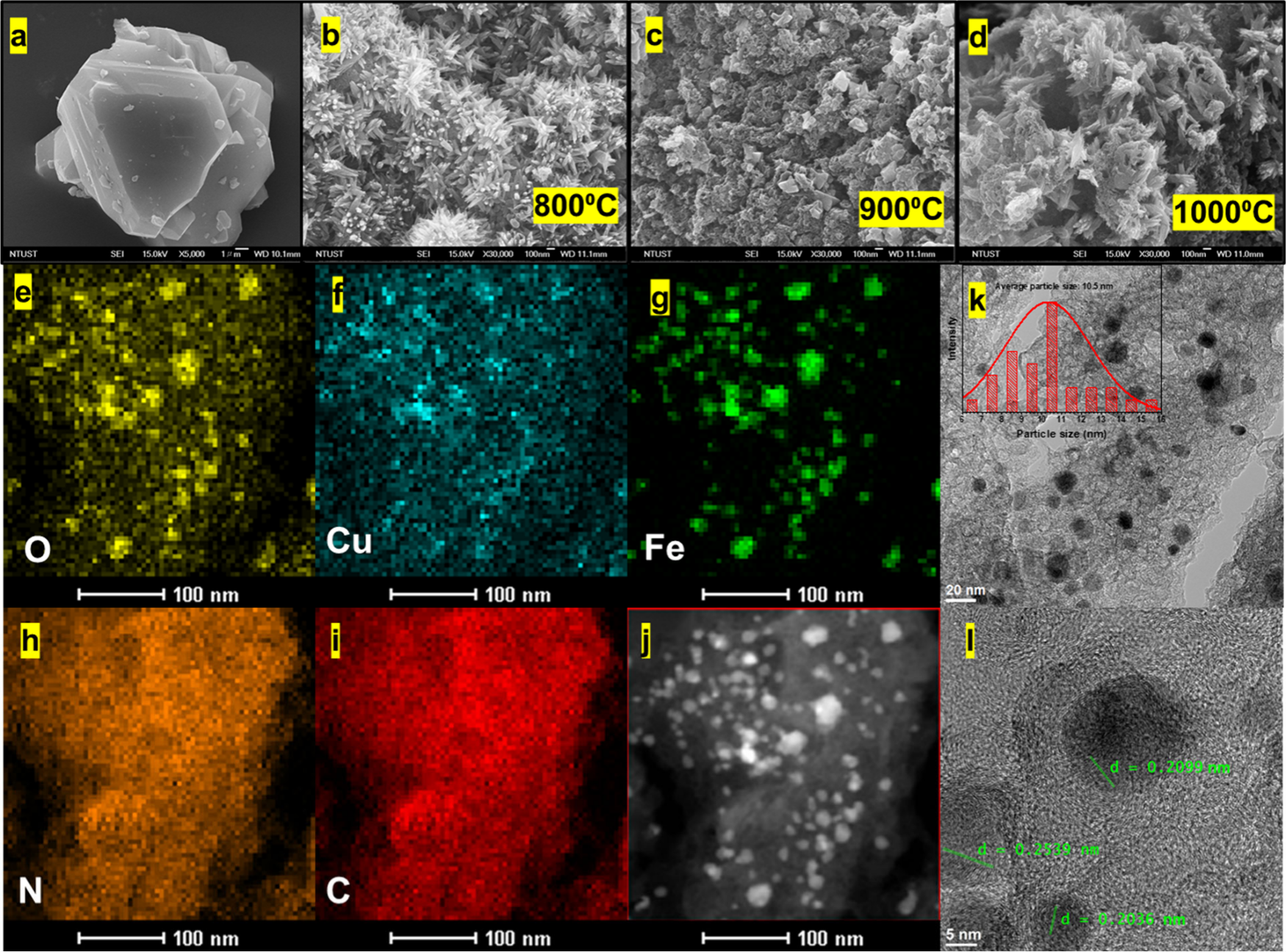
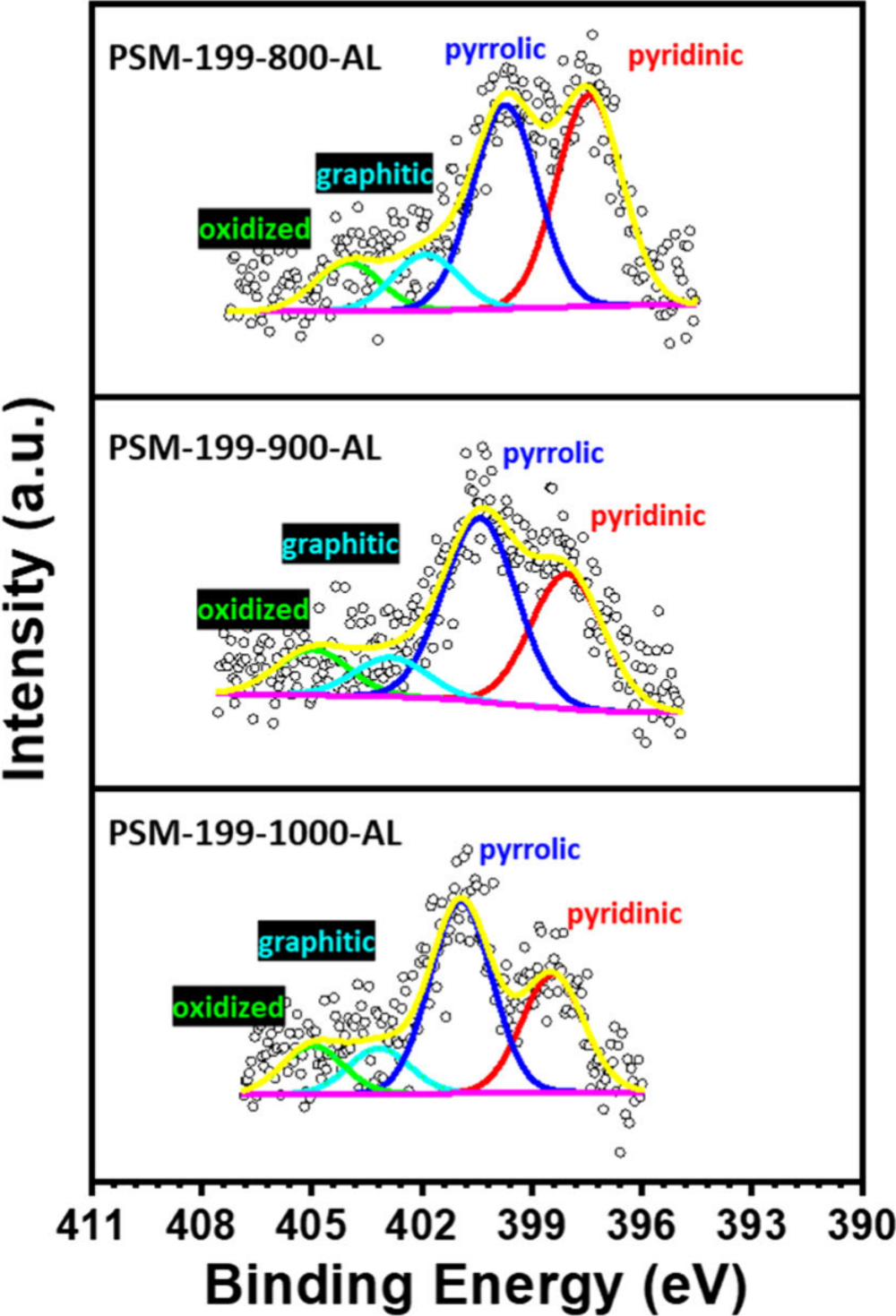
900°C optimal thermal treatment temperature: Comparative study of 700°C, 800°C, 900°C, 1000°C reveals 900°C forms optimal pore size distribution and specific surface area balance; excessively high temperature (1000°C) leads to metal cluster reduction and decreased activity.

📊 Key Figures

Key Figure 1: Electrochemical performance analysis, caption embedded in image.
Key Figure 2: Material structure and stability analysis, caption embedded in image.