← Back to Fuel Cell Research
📄 EML Paper

Atomically dispersed Co-Nx sites anchored on t-ZrO2-embedded porous carbon derived from MOF-808 for enhanced oxygen reduction in alkaline media

International Journal of Hydrogen Energy, 235 (2026) 155243 (Elsevier) | DOI: 10.1016/j.ijhydene.2026.155243
Authors:Berhanu Telay Mekonnen, Yi-Kang Rong, Sun-Tang Chang, Guan-Cheng Chen, Aknachew Mebreku Demeku, Liang-Yun Li, Chen-Hao Wang*

📄 Abstract

Developing efficient, durable non-precious-metal catalysts for the oxygen reduction reaction (ORR) is critical for alkaline anion-exchange membrane fuel cells (AEMFCs). We report MOF-Co-900-NH3, featuring atomically dispersed Co-Nx sites in a nitrogen-doped carbon matrix anchored on tetragonal ZrO2 nanodomains. Synthesized via MOF-templated stabilization and NH3 activation, it exhibits a half-wave potential of 0.81 V and exceptional durability (only a 35 mV shift after 30,000 cycles), outperforming commercial Pt/C. In AEMFC tests, it delivers a peak power density of 359.2 mW cm-2, surpassing the Pt/C benchmark. Spectroscopic analyses reveal that NH3 activation optimizes the electronic structure of Co-Nx moieties, thereby improving charge transfer. This superior performance stems from the synergy among enriched Co-Nx sites, robust oxide-carbon interfaces, and hierarchical porosity, thereby establishing a viable strategy for next-generation Pt-free electrocatalysts.

🔬 Key Findings

1
MOF-Co-900-NH3 Naming: MOF-808 as precursor → MOF-templated stabilization + NH3 activation + pyrolysis at 900°C → atomically dispersed Co-Nx sites anchored on t-ZrO2 nanodomains in N-doped carbon matrix.
2
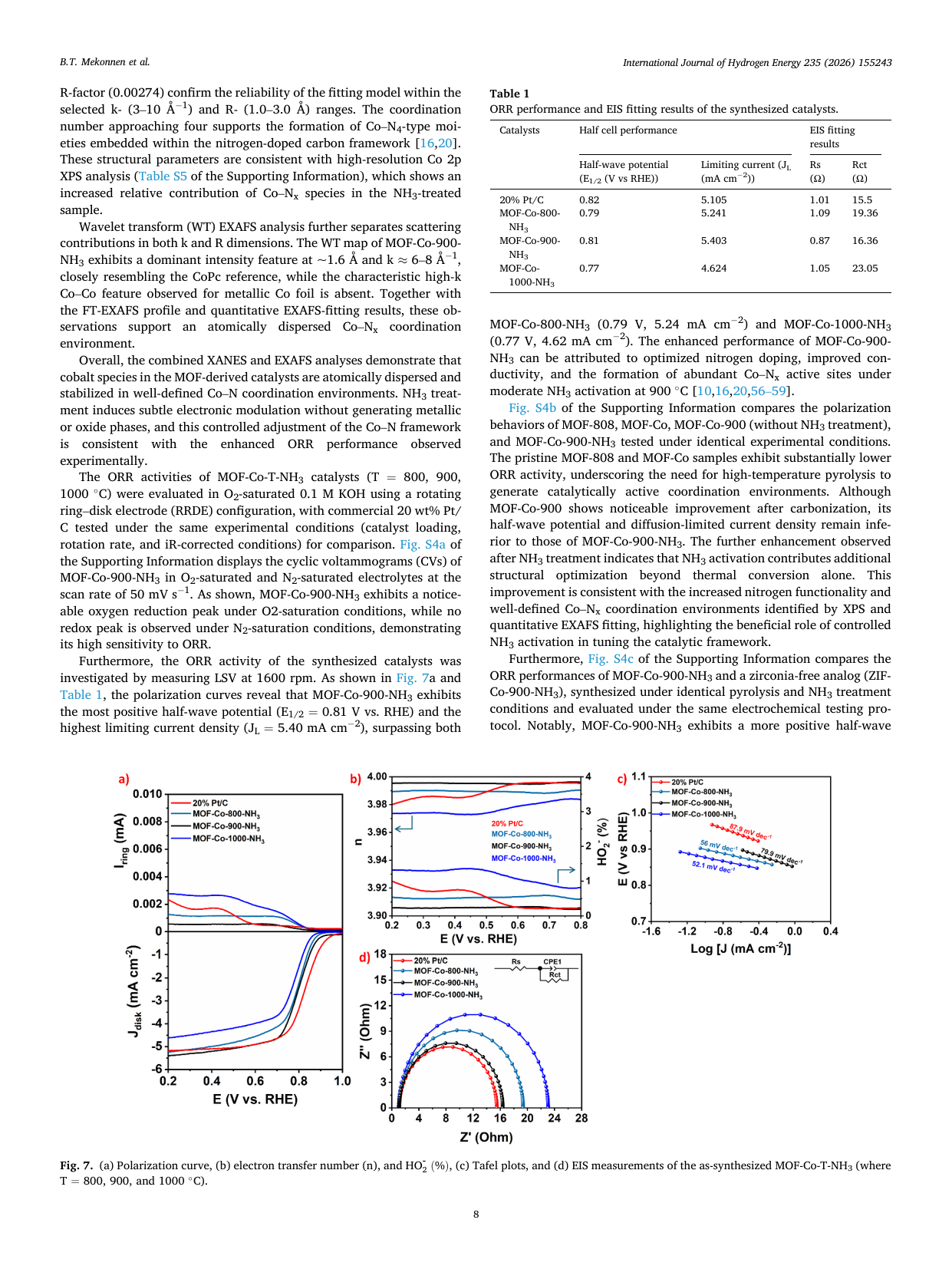
Half-wave potential: 0.81 V vs. RHE: Exceeds commercial Pt/C; electron transfer number n ≈ 3.95 (near 4-electron pathway).
3
Only 35 mV shift after 30,000 cycles: Far superior to commercial Pt/C (ΔE1/2 = 50 mV). XPS confirms Co-Nx coordination environment preserved after ADT.
4
AEMFC peak power density: 359.2 mW cm⁻²: Surpasses Pt/C benchmark (326.9 mW cm⁻²), demonstrating practical fuel cell applicability.
5
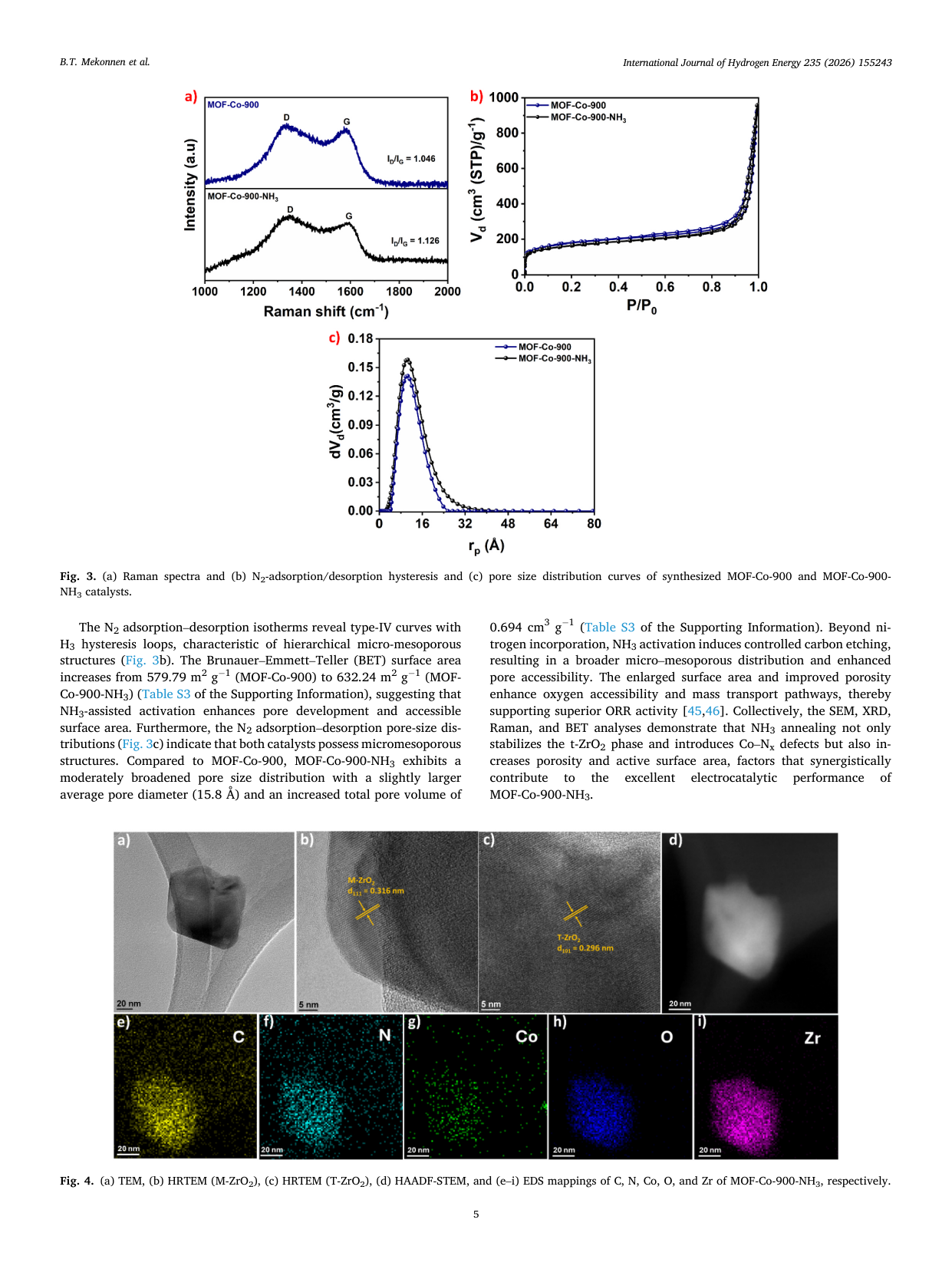
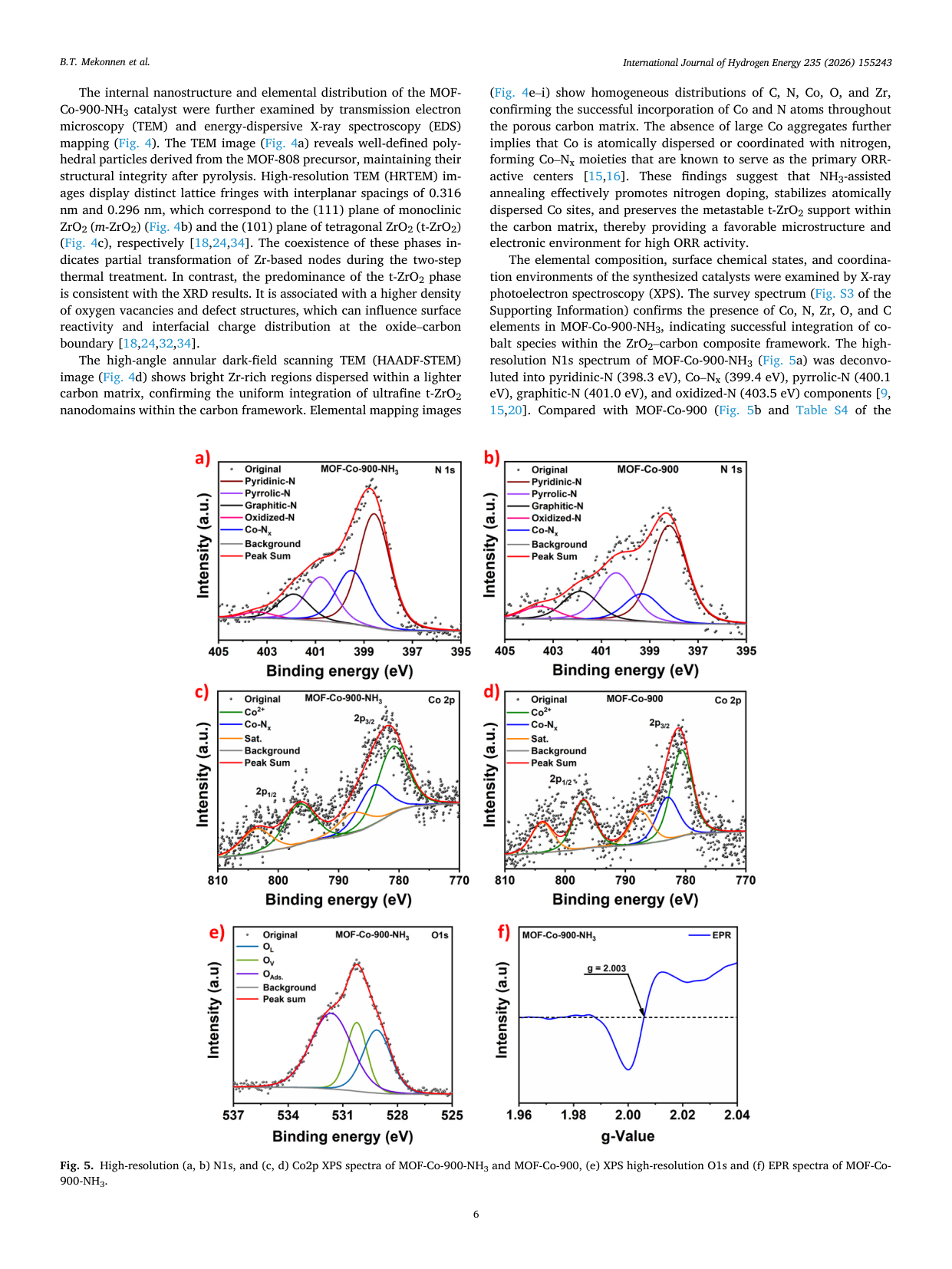
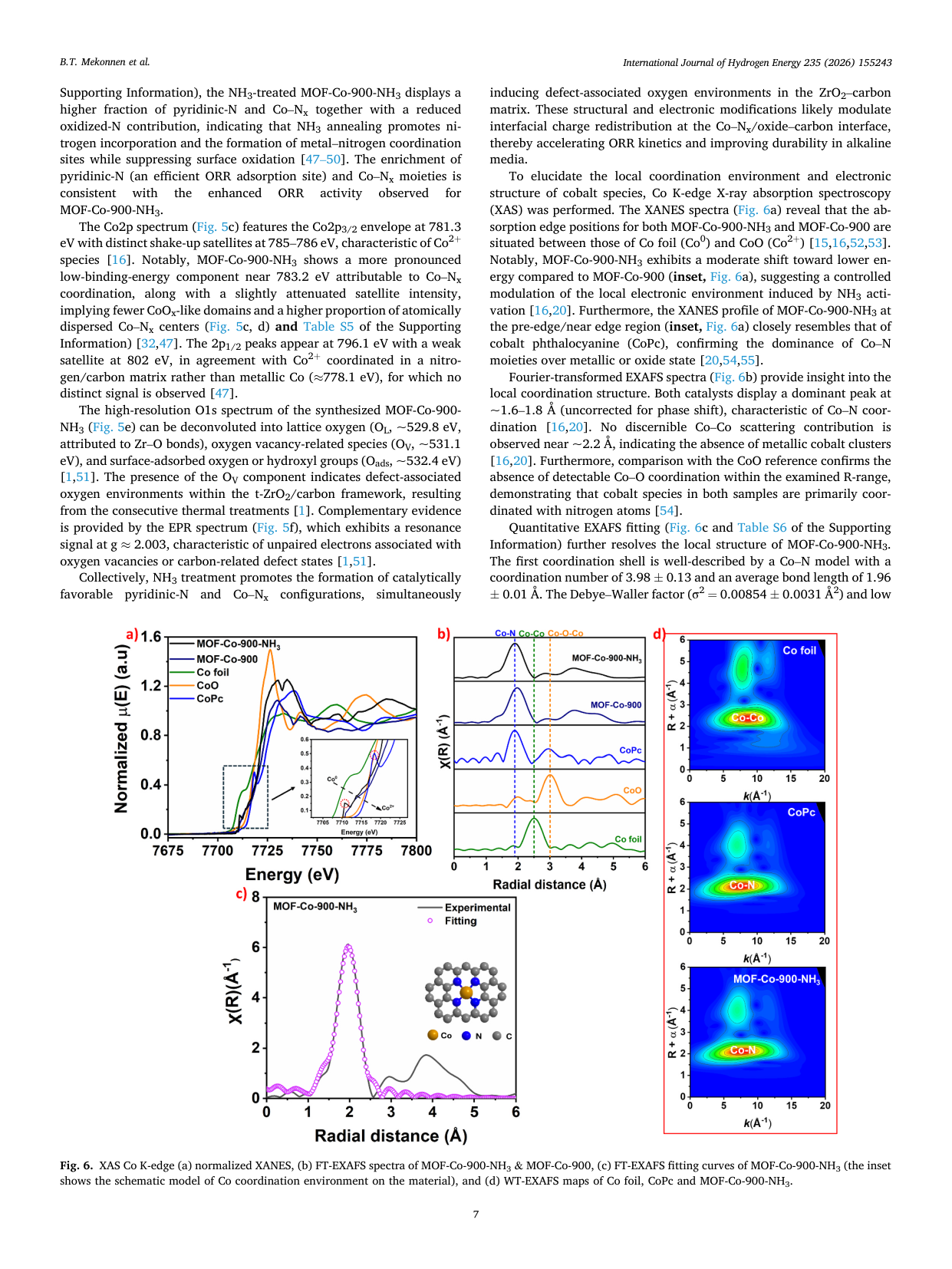
NH3 Activation Optimizes Electronic Structure: XANES, EXAFS, EPR, and XPS confirm NH3 activation tailors Co-Nx electronic structure, enhancing charge transfer. Superior performance stems from synergy: enriched Co-Nx sites + robust oxide-carbon interfaces + hierarchical porosity.

📊 Key Figures

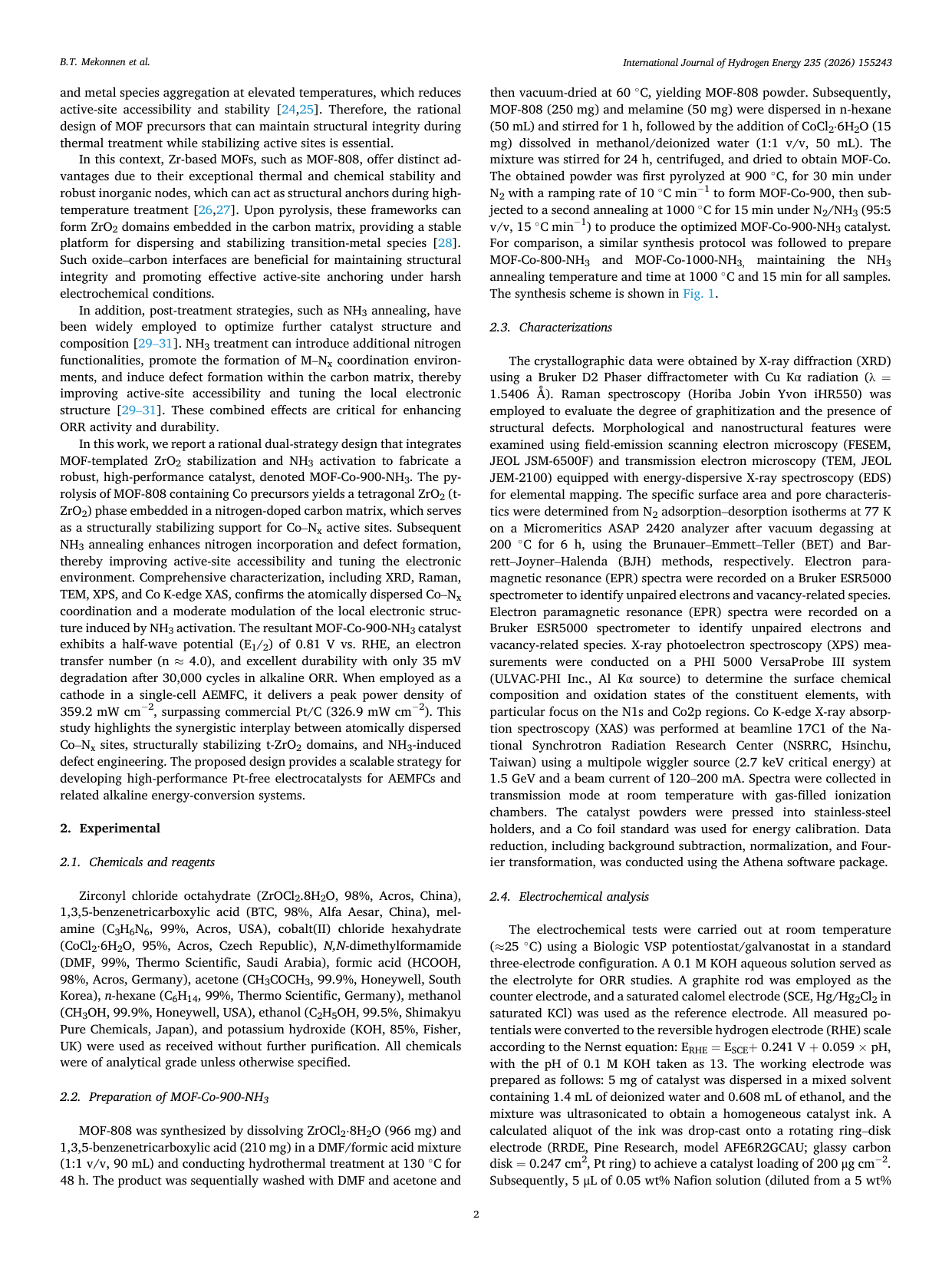
Fig 1: Synthesis scheme
Fig 1. Synthesis scheme of MOF-Co-900-NH3.
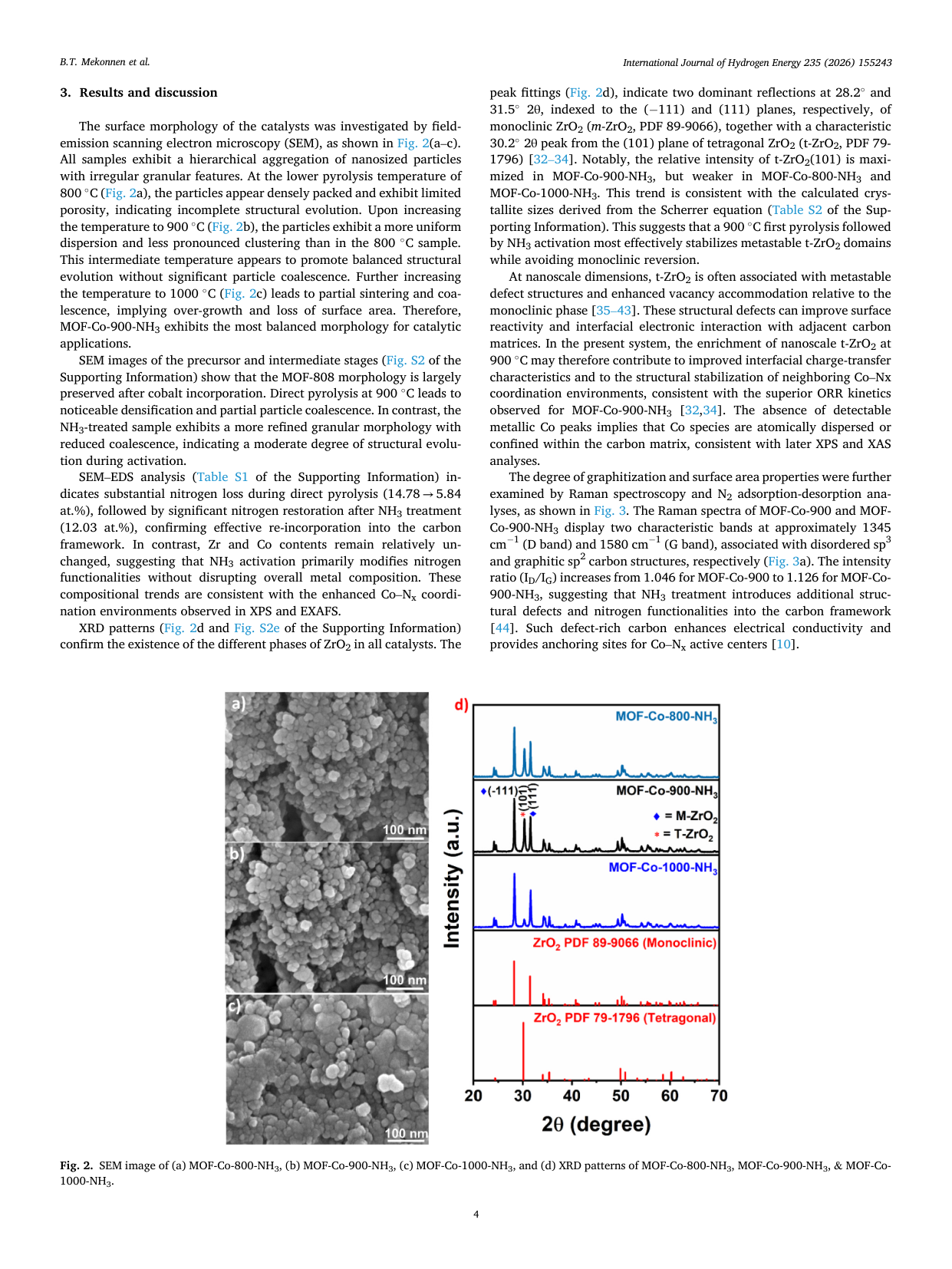
Fig 2: SEM and XRD
Fig 2. SEM images at (a) 800°C, (b) 900°C, (c) 1000°C and (d) XRD patterns.
Fig 3: Raman and BET
Fig 3. (a) Raman spectra, (b) N2 adsorption/desorption, (c) pore size distribution.
Fig 4: TEM and EDS
Fig 4. (a) TEM, (b,c) HRTEM, (d) HAADF-STEM, (e-i) EDS elemental mappings.
Fig 5: XPS and EPR
Fig 5. High-resolution N1s, Co2p XPS spectra, O1s and EPR spectra.
Fig 6: XAS analysis
Fig 6. Co K-edge XAS: (a) XANES, (b) FT-EXAFS, (c) fitting curves.
Fig 7: Electrochemical performance
Fig 7. (a) Polarization curves, (b) electron transfer number, (c) Tafel plots, (d) EIS.
Fig 8: ADT durability
Fig 8. ADT durability: (a) MOF-Co-900-NH3 and (b) Pt/C after 30,000 cycles.