Unveiling the TiZrNbTaFeCx high entropy alloy carbide coatings fabricated by superimposed HiPIMS-MF technique — effect of carbon contents on the microstructure, mechanical properties, and corrosion resistance
📄 Abstract
In this research, TiZrNbTaFe high entropy alloy (HEA) and five TiZrNbTaFeCx HEA carbide coatings with different carbon contents were fabricated by a superimposed HiPIMS-MF system under different C₂H₂ gas flow rates. The phase structure of the coating changed from amorphous to FCC at 32.40 at.% carbon. Hardness increased from 7.7 to 22.1 GPa as the carbon content increased from 0 to 32.40 at.%, then decreased to 19.5 GPa at 35.78 at.% C due to too much soft amorphous carbon phase. The HEA coating with the highest carbon content of 35.78 at.% exhibited the best wear resistance, with a lower coefficient of friction of 0.21 and the lowest wear rate of 3.80 × 10⁻⁶ mm³N⁻¹m⁻¹. According to the potentiodynamic polarization and electrochemical impedance spectroscopy tests, the TiZrNbTaFe coating exhibited excellent corrosion resistance in 0.5 M H₂SO₄, which is 802.7 times better than that of bare AISI 52100. We can conclude that the 35.78 at.% C contained TiZrNbTaFeC HEA carbide coating exhibited a hardness of 19.5 GPa, excellent tribological performance, and the second-best corrosion resistance, which can be used in severely corrosive and stress bearing environments.
🔬 Five Core Findings
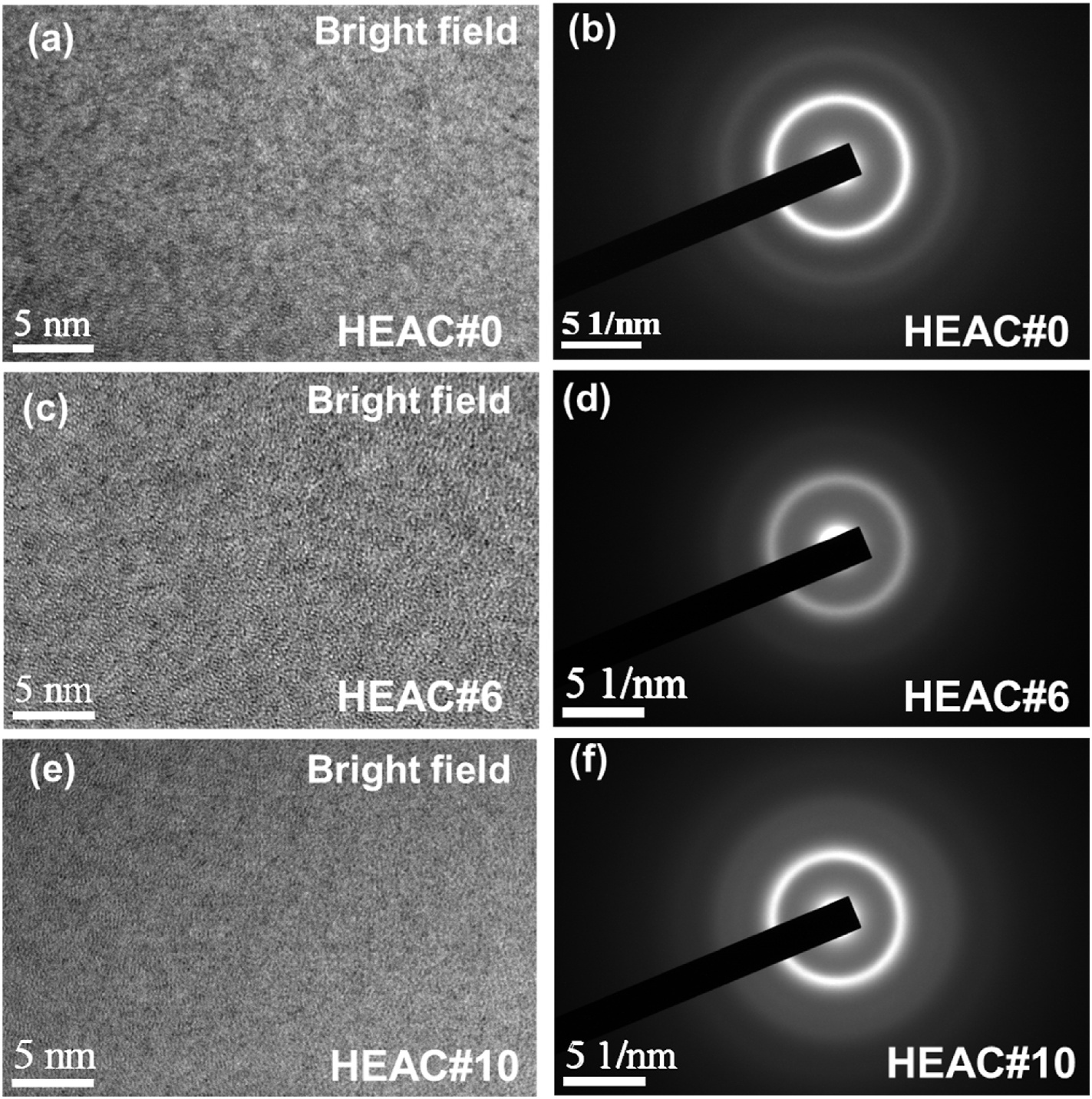
The coating structure transitions from amorphous to FCC phase as carbon content increases. At 32.40 at.% C, distinct (111), (200), (220) diffraction rings are observed, confirming FCC nanocrystalline phase formation.
Hardness increases with carbon content, reaching peak value of 22.1 GPa at 32.40 at.% C; further increasing to 35.78 at.% C causes hardness to decrease to 19.5 GPa due to excess soft amorphous carbon phase, exhibiting a bell-shaped relationship.
Coating with 35.78 at.% C exhibits the lowest friction coefficient (0.21) and lowest wear rate, attributed to dense FCC structure and carbide strengthening effects.
TiZrNbTaFe coating in 0.5 M H₂SO₄ shows extremely low corrosion current density, with corrosion resistance 802.7 times better than bare AISI 52100, demonstrating excellent corrosion protection potential of HEA carbide coatings.
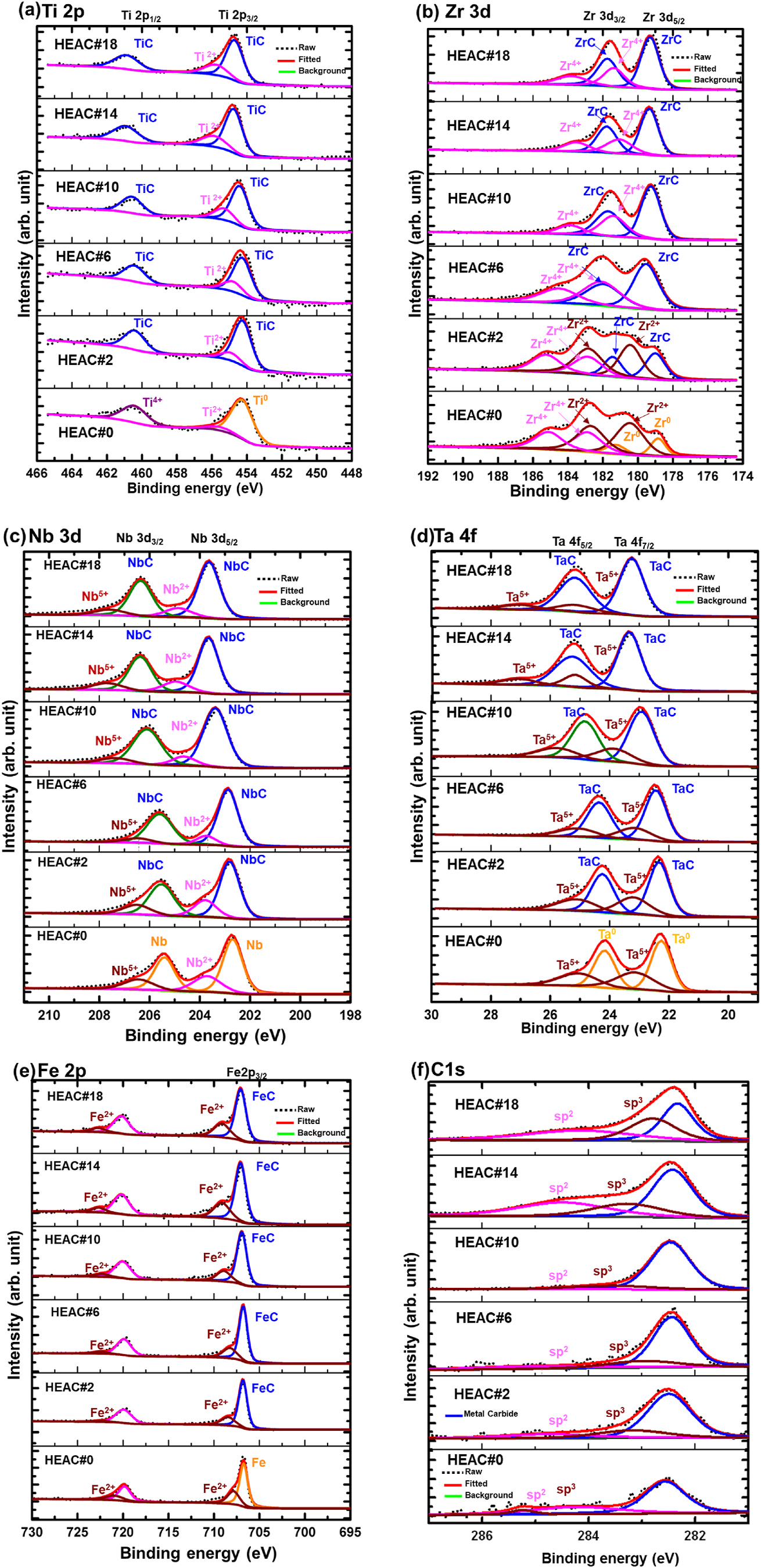
X-ray photoelectron spectroscopy analysis reveals characteristic peaks of TiC, ZrC, NbC, TaC, FeC metal carbides, confirming successful carbon incorporation and bond formation with constituent metals.
📊 Key Figures